


Page 64 - Read Online
P. 64
Liu et al. Soft Sci 2024;4:44  https://dx.doi.org/10.20517/ss.2024.59            Page 7 of 21


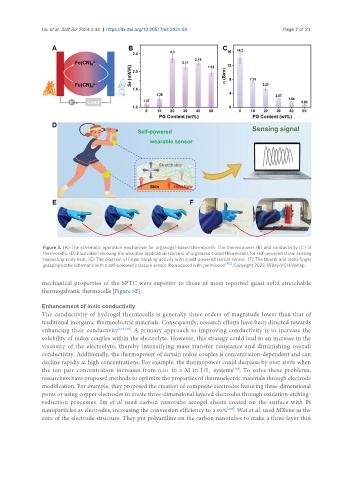
                Figure 3. (A) The schematic operation mechanism for organogel-based thermocells. The thermopower (B) and conductivity (C) of
                thermocells. (D) Illustration showing the wearable application scenario of organized-based thermocells for self-powered strain sensing
                harvesting body heat. (E) The diagram of finger bending activity with a self-powered tensile sensor. (F) The thumb and index finger
                grasping bottle schematic with a self-powered pressure sensor. Reproduced with permission [102] . Copyright 2023, Wiley-VCH Verlag.


               mechanical properties of the SPTC were superior to those of most reported quasi-solid stretchable
               thermogalvanic thermocells [Figure 5E].


               Enhancement of ionic conductivity
               The conductivity of hydrogel thermocells is generally three orders of magnitude lower than that of
               traditional inorganic thermoelectric materials. Consequently, research efforts have been directed towards
               enhancing their conductivity [104-106] . A primary approach to improving conductivity is to increase the
               solubility of redox couples within the electrolyte. However, this strategy could lead to an increase in the
               viscosity of the electrolyte, thereby intensifying mass transfer resistance and diminishing overall
               conductivity. Additionally, the thermopower of certain redox couples is concentration-dependent and can
               decline rapidly at high concentrations. For example, the thermopower could decrease by over 400% when
                                                                                [107]
               the ion pair concentration increases from 0.01 to 2 M in I /I  systems . To solve these problems,
                                                                        -
                                                                     -
                                                                       3
               researchers have proposed methods to optimize the properties of thermoelectric materials through electrode
               modification. For example, they proposed the creation of composite electrodes featuring three-dimensional
               pores or using copper electrodes to create three-dimensional layered electrodes through oxidation-etching-
               reduction processes. Im et al. used carbon nanotube aerogel sheets coated on the surface with Pt
                                                                              [108]
               nanoparticles as electrodes, increasing the conversion efficiency to 3.95% . Wei et al. used MXene as the
               core of the electrode structure. They put polyaniline on the carbon nanotubes to make a three-layer thin

