


Page 69 - Read Online
P. 69
Page 12 of 21                             Liu et al. Soft Sci 2024;4:44  https://dx.doi.org/10.20517/ss.2024.59


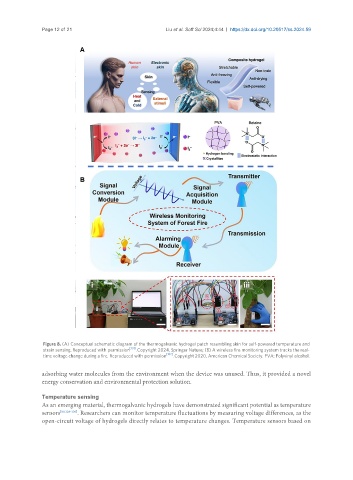
                Figure 8. (A) Conceptual schematic diagram of the thermogalvanic hydrogel patch resembling skin for self-powered temperature and
                strain sensing. Reproduced with permission [131] . Copyright 2024, Springer Nature; (B) A wireless fire monitoring system tracks the real-
                time voltage change during a fire. Reproduced with permission [132] . Copyright 2020, American Chemical Society. PVA: Polyvinyl alcohol.


               adsorbing water molecules from the environment when the device was unused. Thus, it provided a novel
               energy conservation and environmental protection solution.

               Temperature sensing
               As an emerging material, thermogalvanic hydrogels have demonstrated significant potential as temperature
               sensors [89,128-130] . Researchers can monitor temperature fluctuations by measuring voltage differences, as the
               open-circuit voltage of hydrogels directly relates to temperature changes. Temperature sensors based on

