


Page 68 - Read Online
P. 68
Liu et al. Soft Sci 2024;4:44  https://dx.doi.org/10.20517/ss.2024.59           Page 11 of 21


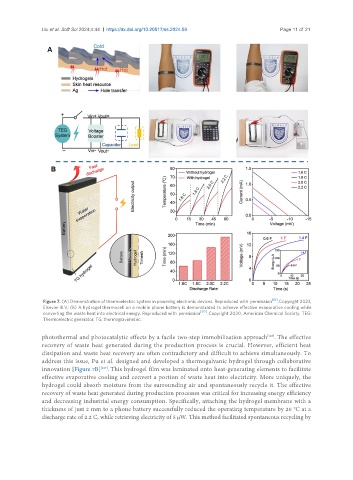
                Figure 7. (A) Demonstration of thermoelectric system in powering electronic devices. Reproduced with permission [83] . Copyright 2023,
                Elsevier B.V; (B) A hydrogel thermocell on a mobile phone battery is demonstrated to achieve effective evaporative cooling while
                converting the waste heat into electrical energy. Reproduced with  permission [127] . Copyright 2020, American Chemical Society. TEG:
                Thermoelectric generator; TG: thermogravimetric.

               photothermal and photocatalytic effects by a facile two-step immobilization approach . The effective
                                                                                           [126]
               recovery of waste heat generated during the production process is crucial. However, efficient heat
               dissipation and waste heat recovery are often contradictory and difficult to achieve simultaneously. To
               address this issue, Pu et al. designed and developed a thermogalvanic hydrogel through collaborative
                                   [127]
               innovation [Figure 7B] . This hydrogel film was laminated onto heat-generating elements to facilitate
               effective evaporative cooling and convert a portion of waste heat into electricity. More uniquely, the
               hydrogel could absorb moisture from the surrounding air and spontaneously recycle it. The effective
               recovery of waste heat generated during production processes was critical for increasing energy efficiency
               and decreasing industrial energy consumption. Specifically, attaching the hydrogel membrane with a
                                                                                                    o
               thickness of just 2 mm to a phone battery successfully reduced the operating temperature by 20  C at a
               discharge rate of 2.2 C, while retrieving electricity of 5 μW. This method facilitated spontaneous recycling by

