


Page 62 - Read Online
P. 62
Liu et al. Soft Sci 2024;4:44  https://dx.doi.org/10.20517/ss.2024.59            Page 5 of 21

               ability to generate electromotive force unit temperature difference. This parameter is an essential factor in
                                                                                    [90]
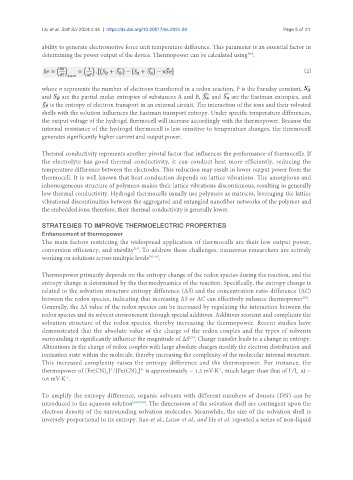
               determining the power output of the device. Thermopower can be calculated using :
                                                                                                        (2)


               where n represents the number of electrons transferred in a redox reaction, F is the Faraday constant, SA
               and SB are the partial molar entropies of substances A and B, SA and SB are the Eastman entropies, and
               SE is the entropy of electron transport in an external circuit. The interaction of the ions and their solvated
               shells with the solution influences the Eastman transport entropy. Under specific temperature differences,
               the output voltage of the hydrogel thermocell will increase accordingly with the thermopower. Because the
               internal resistance of the hydrogel thermocell is less sensitive to temperature changes, the thermocell
               generates significantly higher current and output power.


               Thermal conductivity represents another pivotal factor that influences the performance of thermocells. If
               the electrolyte has good thermal conductivity, it can conduct heat more efficiently, reducing the
               temperature difference between the electrodes. This reduction may result in lower output power from the
               thermocell. It is well known that heat conduction depends on lattice vibrations. The amorphous and
               inhomogeneous structure of polymers makes their lattice vibrations discontinuous, resulting in generally
               low thermal conductivity. Hydrogel thermocells usually use polymers as matrices, leveraging the lattice
               vibrational discontinuities between the aggregated and entangled nanofiber networks of the polymer and
               the embedded ions; therefore, their thermal conductivity is generally lower.


               STRATEGIES TO IMPROVE THERMOELECTRIC PROPERTIES
               Enhancement of thermopower
               The main factors restricting the widespread application of thermocells are their low output power,
               conversion efficiency, and stability . To address these challenges, numerous researchers are actively
                                              [91]
               working on solutions across multiple levels [92-96] .

               Thermopower primarily depends on the entropy change of the redox species during the reaction, and the
               entropy change is determined by the thermodynamics of the reaction. Specifically, the entropy change is
               related to the solvation structure entropy difference (∆S) and the concentration ratio difference (∆C)
               between the redox species, indicating that increasing ∆S or ∆C can effectively enhance thermopower .
                                                                                                       [30]
               Generally, the ∆S value of the redox species can be increased by regulating the interaction between the
               redox species and its solvent environment through special additives. Additives reorient and complicate the
               solvation structure of the redox species, thereby increasing the thermopower. Recent studies have
               demonstrated that the absolute value of the charge of the redox couples and the types of solvents
               surrounding it significantly influence the magnitude of ∆S . Charge transfer leads to a change in entropy.
                                                                 [29]
               Alterations in the charge of redox couples with large absolute charges modify the electron distribution and
               ionization state within the molecule, thereby increasing the complexity of the molecular internal structure.
               This increased complexity raises the entropy difference and the thermopower. For instance, the
               thermopower of [Fe(CN) ] /[Fe(CN) ]  is approximately ~ 1.3 mV·K , much larger than that of I /I  at ~
                                      3-
                                                4-
                                                                                                     -
                                                                                                   -
                                                                           -1
                                                                                                     3
                                     6
                                               6
               0.6 mV·K .
                       -1
               To amplify the entropy difference, organic solvents with different numbers of donors (DN) can be
               introduced to the aqueous solution [66,97,98] . The dimensions of the solvation shell are contingent upon the
               electron density of the surrounding solvation molecules. Meanwhile, the size of the solvation shell is
               inversely proportional to its entropy. Jiao et al., Lazar et al., and He et al. reported a series of non-liquid

