


Page 44 - Read Online
P. 44
Zhang et al. Soft Sci 2024;4:39  https://dx.doi.org/10.20517/ss.2024.34         Page 15 of 28


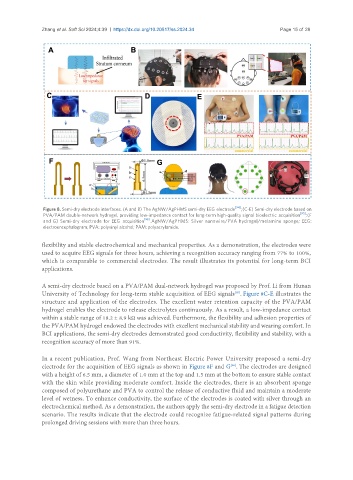
                Figure 8. Semi-dry electrode interfaces. (A and B) The AgNW/AgPHMS semi-dry EEG electrode [94] ; (C-E) Semi-dry electrode based on
                PVA/PAM double-network hydrogel, providing low-impedance contact for long-term high-quality signal bioelectric  acquisition [95] ; (F
                and  G)  Semi-dry  electrode  for  EEG  acquisition [96] . AgNW/AgPHMS:  Silver  nanowire/PVA  hydrogel/melamine  sponge;  EEG:
                electroencephalogram; PVA: polyvinyl alcohol; PAM: polyacrylamide.


               flexibility and stable electrochemical and mechanical properties. As a demonstration, the electrodes were
               used to acquire EEG signals for three hours, achieving a recognition accuracy ranging from 77% to 100%,
               which is comparable to commercial electrodes. The result illustrates its potential for long-term BCI
               applications.

               A semi-dry electrode based on a PVA/PAM dual-network hydrogel was proposed by Prof. Li from Hunan
                                                                                [95]
               University of Technology for long-term stable acquisition of EEG signals . Figure 8C-E illustrates the
               structure and application of the electrodes. The excellent water retention capacity of the PVA/PAM
               hydrogel enables the electrode to release electrolytes continuously. As a result, a low-impedance contact
               within a stable range of 18.2 ± 8.9 kΩ was achieved. Furthermore, the flexibility and adhesion properties of
               the PVA/PAM hydrogel endowed the electrodes with excellent mechanical stability and wearing comfort. In
               BCI applications, the semi-dry electrodes demonstrated good conductivity, flexibility and stability, with a
               recognition accuracy of more than 91%.


               In a recent publication, Prof. Wang from Northeast Electric Power University proposed a semi-dry
               electrode for the acquisition of EEG signals as shown in Figure 8F and G . The electrodes are designed
                                                                               [96]
               with a height of 6.5 mm, a diameter of 1.0 mm at the top and 1.5 mm at the bottom to ensure stable contact
               with the skin while providing moderate comfort. Inside the electrodes, there is an absorbent sponge
               composed of polyurethane and PVA to control the release of conductive fluid and maintain a moderate
               level of wetness. To enhance conductivity, the surface of the electrodes is coated with silver through an
               electrochemical method. As a demonstration, the authors apply the semi-dry electrode in a fatigue detection
               scenario. The results indicate that the electrode could recognize fatigue-related signal patterns during
               prolonged driving sessions with more than three hours.

