


Page 46 - Read Online
P. 46
Zhang et al. Soft Sci 2024;4:39  https://dx.doi.org/10.20517/ss.2024.34         Page 17 of 28


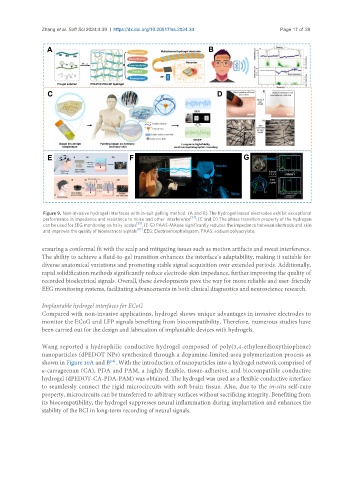
                Figure 9. Non-invasive hydrogel interfaces with in-suit gelling method. (A and B) The hydrogel-based electrodes exhibit exceptional
                                                                 [34]
                performance in impedance and resistance to noise and other interference  ; (C and D) The phase transition property of the hydrogen
                can be used for EEG monitoring on hairy scalps [35] ; (E-G) PAAS-MXene significantly reduces the impedance between electrode and skin
                and improves the quality of bioelectrical signals [97] . EEG: Electroencephalogram; PAAS: sodium polyacrylate.

               ensuring a conformal fit with the scalp and mitigating issues such as motion artifacts and sweat interference.
               The ability to achieve a fluid-to-gel transition enhances the interface’s adaptability, making it suitable for
               diverse anatomical variations and promoting stable signal acquisition over extended periods. Additionally,
               rapid solidification methods significantly reduce electrode-skin impedance, further improving the quality of
               recorded bioelectrical signals. Overall, these developments pave the way for more reliable and user-friendly
               EEG monitoring systems, facilitating advancements in both clinical diagnostics and neuroscience research.


               Implantable hydrogel interfaces for ECoG
               Compared with non-invasive applications, hydrogel shows unique advantages in invasive electrodes to
               monitor the ECoG and LFP signals benefiting from biocompatibility. Therefore, numerous studies have
               been carried out for the design and fabrication of implantable devices with hydrogels.


               Wang reported a hydrophilic conductive hydrogel composed of poly(3,4-ethylenedioxythiophene)
               nanoparticles (dPEDOT NPs) synthesized through a dopamine-limited area polymerization process as
               shown in Figure 10A and B . With the introduction of nanoparticles into a hydrogel network comprised of
                                      [98]
               κ-carrageenan (CA), PDA and PAM, a highly flexible, tissue-adhesive, and biocompatible conductive
               hydrogel (dPEDOT-CA-PDA-PAM) was obtained. The hydrogel was used as a flexible conductive interface
               to seamlessly connect the rigid microcircuits with soft brain tissue. Also, due to the in-situ self-cure
               property, microcircuits can be transferred to arbitrary surfaces without sacrificing integrity. Benefiting from
               its biocompatibility, the hydrogel suppresses neural inflammation during implantation and enhances the
               stability of the BCI in long-term recording of neural signals.

