


Page 50 - Read Online
P. 50
Zhang et al. Soft Sci 2024;4:39  https://dx.doi.org/10.20517/ss.2024.34         Page 21 of 28


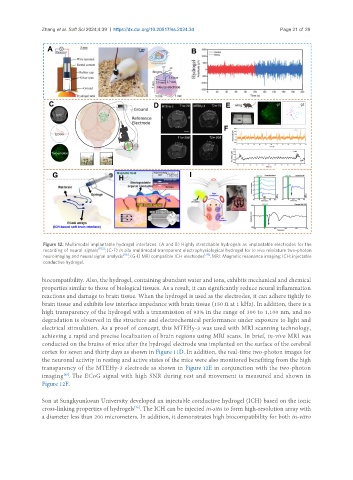
                Figure 12. Multimodal implantable hydrogel interfaces. (A and B) Highly stretchable hydrogels as implantable electrodes for the
                recording of neural  signals [102] ; (C-F) In situ multimodal transparent electrophysiological hydrogel for in vivo miniature two-photon
                neuroimaging and neural signal analysis [85] ; (G-I) MRI compatible ICH electrodes [76] . MRI: Magnetic resonance imaging; ICH: injectable
                conductive hydrogel.

               biocompatibility. Also, the hydrogel, containing abundant water and ions, exhibits mechanical and chemical
               properties similar to those of biological tissues. As a result, it can significantly reduce neural inflammation
               reactions and damage to brain tissue. When the hydrogel is used as the electrodes, it can adhere tightly to
               brain tissue and exhibits low interface impedance with brain tissue (150 Ω at 1 kHz). In addition, there is a
               high transparency of the hydrogel with a transmission of 93% in the range of 300 to 1,100 nm, and no
               degradation is observed in the structure and electrochemical performance under exposure to light and
               electrical stimulation. As a proof of concept, this MTEHy-3 was used with MRI scanning technology,
               achieving a rapid and precise localization of brain regions using MRI scans. In brief, in-vivo MRI was
               conducted on the brains of mice after the hydrogel electrode was implanted on the surface of the cerebral
               cortex for seven and thirty days as shown in Figure 11D. In addition, the real-time two-photon images for
               the neuronal activity in resting and active states of the mice were also monitored benefiting from the high
               transparency of the MTEHy-3 electrode as shown in Figure 12E in conjunction with the two-photon
               imaging . The ECoG signal with high SNR during rest and movement is measured and shown in
                      [85]
               Figure 12F.


               Son at Sungkyunkwan University developed an injectable conductive hydrogel (ICH) based on the ionic
               cross-linking properties of hydrogels . The ICH can be injected in-situ to form high-resolution array with
                                              [76]
               a diameter less than 200 micrometers. In addition, it demonstrates high biocompatibility for both in-vitro

