


Page 49 - Read Online
P. 49
Page 20 of 28                          Zhang et al. Soft Sci 2024;4:39  https://dx.doi.org/10.20517/ss.2024.34


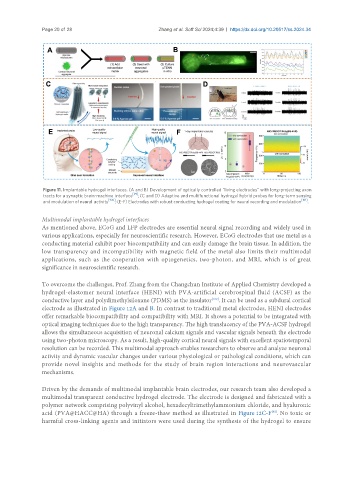
                Figure 11. Implantable hydrogel interfaces. (A and B) Development of optically controlled “living electrodes” with long-projecting axon
                tracts for a synaptic brain-machine interface [99] ; (C and D) Adaptive and multifunctional hydrogel hybrid probes for long-term sensing
                and modulation of neural activity [100] ; (E-F) Electrodes with robust conducting hydrogel coating for neural recording and modulation [101] .

               Multimodal implantable hydrogel interfaces
               As mentioned above, ECoG and LFP electrodes are essential neural signal recording and widely used in
               various applications, especially for neuroscientific research. However, ECoG electrodes that use metal as a
               conducting material exhibit poor biocompatibility and can easily damage the brain tissue. In addition, the
               low transparency and incompatibility with magnetic field of the metal also limits their multimodal
               applications, such as the cooperation with optogenetics, two-photon, and MRI, which is of great
               significance in neuroscientific research.

               To overcome the challenges, Prof. Zhang from the Changchun Institute of Applied Chemistry developed a
               hydrogel-elastomer neural interface (HENI) with PVA-artificial cerebrospinal fluid (ACSF) as the
               conductive layer and polydimethylsiloxane (PDMS) as the insulator . It can be used as a subdural cortical
                                                                        [102]
               electrode as illustrated in Figure 12A and B. In contrast to traditional metal electrodes, HENI electrodes
               offer remarkable biocompatibility and compatibility with MRI. It shows a potential to be integrated with
               optical imaging techniques due to the high transparency. The high translucency of the PVA-ACSF hydrogel
               allows the simultaneous acquisition of neuronal calcium signals and vascular signals beneath the electrode
               using two-photon microscopy. As a result, high-quality cortical neural signals with excellent spatiotemporal
               resolution can be recorded. This multimodal approach enables researchers to observe and analyze neuronal
               activity and dynamic vascular changes under various physiological or pathological conditions, which can
               provide novel insights and methods for the study of brain region interactions and neurovascular
               mechanisms.

               Driven by the demands of multimodal implantable brain electrodes, our research team also developed a
               multimodal transparent conductive hydrogel electrode. The electrode is designed and fabricated with a
               polymer network comprising polyvinyl alcohol, hexadecyltrimethylammonium chloride, and hyaluronic
                                                                                             [85]
               acid (PVA@HACC@HA) through a freeze-thaw method as illustrated in Figure 12C-F . No toxic or
               harmful cross-linking agents and initiators were used during the synthesis of the hydrogel to ensure

