


Page 47 - Read Online
P. 47
Page 18 of 28                          Zhang et al. Soft Sci 2024;4:39  https://dx.doi.org/10.20517/ss.2024.34


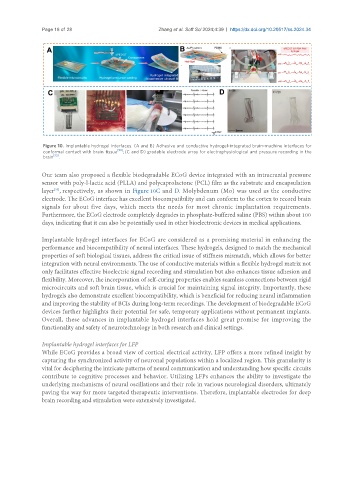
                Figure 10. Implantable hydrogel interfaces. (A and B) Adhesive and conductive hydrogel-integrated brain-machine interfaces for
                conformal contact with brain  tissue [98] ; (C and D) gradable electrode array for electrophysiological and pressure recording in the
                brain [33] .

               Our team also proposed a flexible biodegradable ECoG device integrated with an intracranial pressure
               sensor with poly-l-lactic acid (PLLA) and polycaprolactone (PCL) film as the substrate and encapsulation
                   [33]
               layer , respectively, as shown in Figure 10C and D. Molybdenum (Mo) was used as the conductive
               electrode. The ECoG interface has excellent biocompatibility and can conform to the cortex to record brain
               signals for about five days, which meets the needs for most chronic implantation requirements.
               Furthermore, the ECoG electrode completely degrades in phosphate-buffered saline (PBS) within about 100
               days, indicating that it can also be potentially used in other bioelectronic devices in medical applications.


               Implantable hydrogel interfaces for ECoG are considered as a promising material in enhancing the
               performance and biocompatibility of neural interfaces. These hydrogels, designed to match the mechanical
               properties of soft biological tissues, address the critical issue of stiffness mismatch, which allows for better
               integration with neural environments. The use of conductive materials within a flexible hydrogel matrix not
               only facilitates effective bioelectric signal recording and stimulation but also enhances tissue adhesion and
               flexibility. Moreover, the incorporation of self-curing properties enables seamless connections between rigid
               microcircuits and soft brain tissue, which is crucial for maintaining signal integrity. Importantly, these
               hydrogels also demonstrate excellent biocompatibility, which is beneficial for reducing neural inflammation
               and improving the stability of BCIs during long-term recordings. The development of biodegradable ECoG
               devices further highlights their potential for safe, temporary applications without permanent implants.
               Overall, these advances in implantable hydrogel interfaces hold great promise for improving the
               functionality and safety of neurotechnology in both research and clinical settings.


               Implantable hydrogel interfaces for LFP
               While ECoG provides a broad view of cortical electrical activity, LFP offers a more refined insight by
               capturing the synchronized activity of neuronal populations within a localized region. This granularity is
               vital for deciphering the intricate patterns of neural communication and understanding how specific circuits
               contribute to cognitive processes and behavior. Utilizing LFPs enhances the ability to investigate the
               underlying mechanisms of neural oscillations and their role in various neurological disorders, ultimately
               paving the way for more targeted therapeutic interventions. Therefore, implantable electrodes for deep
               brain recording and stimulation were extensively investigated.

