


Page 42 - Read Online
P. 42
Zhang et al. Soft Sci 2024;4:39  https://dx.doi.org/10.20517/ss.2024.34         Page 13 of 28

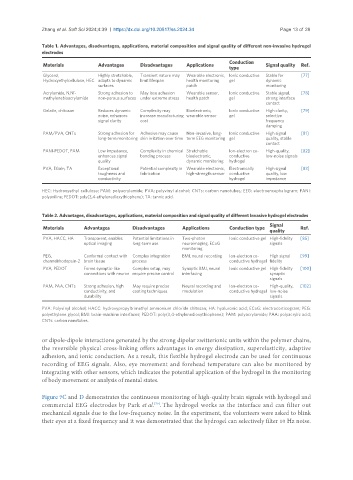
               Table 1. Advantages, disadvantages, applications, material composition and signal quality of different non-invasive hydrogel
               electrodes
                                                                              Conduction
                Materials         Advantages    Disadvantages   Applications               Signal quality  Ref.
                                                                              type
                Glycerol,         Highly stretchable,   Transient nature may   Wearable electronic,  Ionic conductive   Stable for   [77]
                Hydroxyethylcellulose, HEC adapts to dynamic   limit lifespan  health monitoring   gel  dynamic
                                  surfaces                      patch                      monitoring
                Acrylamide, N,N’-  Strong adhesion to   May lose adhesion   Wearable sensor,   Ionic conductive   Stable signal,   [78]
                methylenebisacrylamide  non-porous surfaces under extreme stress  health patch  gel  strong interface
                                                                                           contact
                Gelatin, chitosan  Reduces dynamic   Complexity may   Bioelectronic,   Ionic conductive   High clarity,   [79]
                                  noise, enhances   increase manufacturing  wearable sensor  gel  selective
                                  signal clarity  cost                                     frequency
                                                                                           damping
                PAM/PVA, CNTs     Strong adhesion for   Adhesive may cause   Non-invasive, long-  Ionic conductive   High signal   [81]
                                  long-term monitoring skin irritation over time term EEG monitoring gel  quality, stable
                                                                                           contact
                PANI-PEDOT, PAM   Low impedance,   Complexity in chemical  Stretchable   Ion-electron co-  High-quality,   [82]
                                  enhances signal   bonding process  bioelectronic,   conductive   low-noise signals
                                  quality                       dynamic monitoring  hydrogel
                PVA, EGaIn, TA    Exceptional   Potential complexity in  Wearable electronic,  Electronically   High signal   [83]
                                  toughness and   fabrication   high-strength sensor conductive   quality, low
                                  conductivity                                hydrogel     impedance

               HEC: Hydroxyethyl cellulose; PAM: polyacrylamide; PVA: polyvinyl alcohol; CNTs: carbon nanotubes; EEG: electroencephalogram; PANI:
               polyaniline; PEDOT: poly(3,4-ethylenedioxythiophene); TA: tannic acid.


               Table 2. Advantages, disadvantages, applications, material composition and signal quality of different Invasive hydrogel electrodes
                Materials    Advantages       Disadvantages   Applications    Conduction type  Signal   Ref.
                                                                                            quality
                PVA, HACC, HA  Transparent, enables   Potential limitations in   Two-photon   Ionic conductive gel High-fidelity   [85]
                             optical imaging  long-term use   neuroimaging, ECoG            signals
                                                              monitoring
                PEG,         Conformal contact with  Complex integration   BMI, neural recording  Ion-electron co-  High signal   [99]
                channelrhodopsin-2 brain tissue  process                      conductive hydrogel fidelity
                PVA, PEDOT   Forms synaptic-like   Complex setup, may   Synaptic BMI, neural   Ionic conductive gel High-fidelity   [100]
                             connections with neuron require precise control  interfacing   synaptic
                                                                                            signals
                PAM, PAA, CNTs  Strong adhesion, high   May require precise   Neural recording and   Ion-electron co-  High-quality,   [102]
                             conductivity, and   coating techniques  modulation  conductive hydrogel low-noise
                             durability                                                     signals
               PVA: Polyvinyl alcohol; HACC: hydroxypropyltrimethyl ammonium chloride chitosan; HA: hyaluronic acid; ECoG: electrocorticogram; PEG:
               polyethylene glycol; BMI: brain-machine interfaces; PEDOT: poly(3,4-ethylenedioxythiophene); PAM: polyacrylamide; PAA: polyacrylic acid;
               CNTs: carbon nanotubes.


               or dipole-dipole interactions generated by the strong dipolar zwitterionic units within the polymer chains,
               the reversible physical cross-linking offers advantages in energy dissipation, superelasticity, adaptive
               adhesion, and ionic conduction. As a result, this flexible hydrogel electrode can be used for continuous
               recording of EEG signals. Also, eye movement and forehead temperature can also be monitored by
               integrating with other sensors, which indicates the potential application of the hydrogel in the monitoring
               of body movement or analysis of mental states.


               Figure 7C and D demonstrates the continuous monitoring of high-quality brain signals with hydrogel and
               commercial EEG electrodes by Park et al. . The hydrogel works as the interface and can filter out
                                                     [79]
               mechanical signals due to the low-frequency noise. In the experiment, the volunteers were asked to blink
               their eyes at a fixed frequency and it was demonstrated that the hydrogel can selectively filter 10 Hz noise.

