


Page 40 - Read Online
P. 40
Zhang et al. Soft Sci 2024;4:39  https://dx.doi.org/10.20517/ss.2024.34         Page 11 of 28


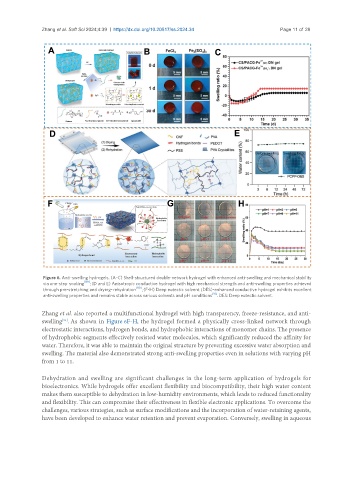
                Figure 6. Anti-swelling hydrogels. (A-C) Shell-structured double-network hydrogel with enhanced anti-swelling and mechanical stability
                via one-step soaking [89] ; (D and E) Anisotropic conductive hydrogel with high mechanical strength and anti-swelling properties achieved
                through pre-stretching and drying-rehydration [90] ; (F-H) Deep eutectic solvent (DES)-enhanced conductive hydrogel exhibits excellent
                anti-swelling properties and remains stable across various solvents and pH conditions [91] . DES: Deep eutectic solvent.

               Zhang et al. also reported a multifunctional hydrogel with high transparency, freeze-resistance, and anti-
               swelling . As shown in Figure 6F-H, the hydrogel formed a physically cross-linked network through
                      [91]
               electrostatic interactions, hydrogen bonds, and hydrophobic interactions of monomer chains. The presence
               of hydrophobic segments effectively resisted water molecules, which significantly reduced the affinity for
               water. Therefore, it was able to maintain the original structure by preventing excessive water absorption and
               swelling. The material also demonstrated strong anti-swelling properties even in solutions with varying pH
               from 1 to 11.


               Dehydration and swelling are significant challenges in the long-term application of hydrogels for
               bioelectronics. While hydrogels offer excellent flexibility and biocompatibility, their high water content
               makes them susceptible to dehydration in low-humidity environments, which leads to reduced functionality
               and flexibility. This can compromise their effectiveness in flexible electronic applications. To overcome the
               challenges, various strategies, such as surface modifications and the incorporation of water-retaining agents,
               have been developed to enhance water retention and prevent evaporation. Conversely, swelling in aqueous

