


Page 9 - Read Online
P. 9
Page 6 of 15                          Romano et al. Soft Sci 2024;4:31  https://dx.doi.org/10.20517/ss.2024.24

               To metrologically characterize the sensors, both static and dynamic tests were conducted. From the graph in
               Figure 2A, it can be observed that the measurable pressure range increases with the stiffness of the soft
               media, and that the mechanical response is linear throughout the deformation range for the FULL and
               DOM shapes and for all materials. This is not the case for the CIL shape; however, the mechanical response
               is linear in the 0%-12.5% deformation range for all shapes and materials. Additionally, the sensor calibration
               curve [Figure 2B] shows the influence of the shape and material on the maximum pressure value measured
               under the same deformation. In the initial state, with zero deformation of the soft medium, the sensor
               output is equal to Vdd/2, indicating its saturation point when the magnet is positioned 2 mm from the Hall
               sensor. Figure 2C illustrates the voltage measured by the Hall sensor as the soft medium undergoes
               deformation across various shapes and materials.


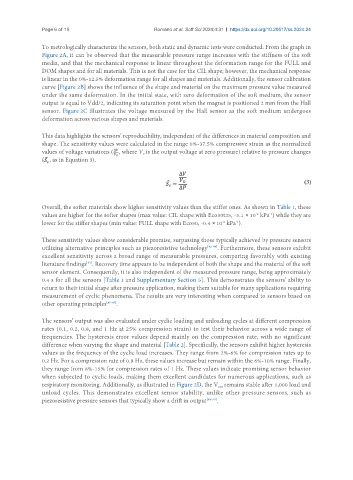
               This data highlights the sensors’ reproducibility, independent of the differences in material composition and
               shape. The sensitivity values were calculated in the range 0%-37.5% compressive strain as the normalized
               values of voltage variations (V, where V  is the output voltage at zero pressure) relative to pressure changes
                                         0
                                                 0
               (S , as in Equation 3).
                 ε


               Overall, the softer materials show higher sensitivity values than the stiffer ones. As shown in Table 1, these
                                                                                            -1
                                                                                       -2
               values are higher for the softer shapes (max value: CIL shape with Eco30t25, -5.1 × 10  kPa ) while they are
                                                                                 -1
                                                                            -2
               lower for the stiffer shapes (min value: FULL shape with Eco50, -0.4 × 10  kPa ).
               These sensitivity values show considerable promise, surpassing those typically achieved by pressure sensors
               utilizing alternative principles such as piezoresistive technology [42-44] . Furthermore, these sensors exhibit
               excellent sensitivity across a broad range of measurable pressures, comparing favorably with existing
                              [31]
               literature findings . Recovery time appears to be independent of both the shape and the material of the soft
               sensor element. Consequently, it is also independent of the measured pressure range, being approximately
               0.4 s for all the sensors [Table 1 and Supplementary Section 5]. This demonstrates the sensors' ability to
               return to their initial shape after pressure application, making them suitable for many applications requiring
               measurement of cyclic phenomena. The results are very interesting when compared to sensors based on
               other operating principles [45-47] .


               The sensors’ output was also evaluated under cyclic loading and unloading cycles at different compression
               rates (0.1, 0.2, 0.8, and 1 Hz at 25% compression strain) to test their behavior across a wide range of
               frequencies. The hysteresis error values depend mainly on the compression rate, with no significant
               difference when varying the shape and material [Table 2]. Specifically, the sensors exhibit higher hysteresis
               values as the frequency of the cyclic load increases. They range from 2%-6% for compression rates up to
               0.2 Hz. For a compression rate of 0.8 Hz, these values increase but remain within the 6%-10% range. Finally,
               they range from 8%-15% for compression rates of 1 Hz. These values indicate promising sensor behavior
               when subjected to cyclic loads, making them excellent candidates for numerous applications, such as
               respiratory monitoring. Additionally, as illustrated in Figure 2D, the V  remains stable after 1,000 load and
                                                                           out
               unload cycles. This demonstrates excellent sensor stability, unlike other pressure sensors, such as
               piezoresistive pressure sensors that typically show a drift in output [48-50] .

