


Page 7 - Read Online
P. 7
Page 4 of 15                          Romano et al. Soft Sci 2024;4:31  https://dx.doi.org/10.20517/ss.2024.24


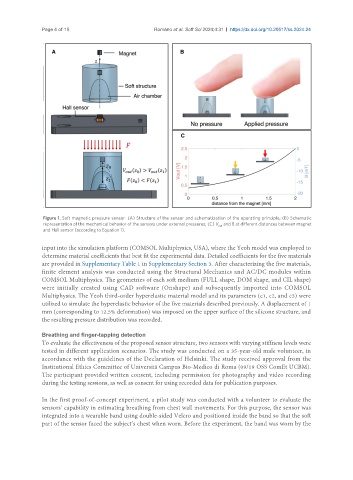
                Figure 1. Soft magnetic pressure sensor. (A) Structure of the sensor and schematization of the operating principle; (B) Schematic
                representation of the mechanical behavior of the sensors under external pressures; (C) V  and B at different distances between magnet
                                                                           out
                and Hall sensor (according to Equation 1).
               input into the simulation platform (COMSOL Multiphysics, USA), where the Yeoh model was employed to
               determine material coefficients that best fit the experimental data. Detailed coefficients for the five materials
               are provided in Supplementary Table 1 in Supplementary Section 3. After characterizing the five materials,
               finite element analysis was conducted using the Structural Mechanics and AC/DC modules within
               COMSOL Multiphysics. The geometries of each soft medium (FULL shape, DOM shape, and CIL shape)
               were initially created using CAD software (Onshape) and subsequently imported into COMSOL
               Multiphysics. The Yeoh third-order hyperelastic material model and its parameters (c1, c2, and c3) were
               utilized to simulate the hyperelastic behavior of the five materials described previously. A displacement of 1
               mm (corresponding to 12.5% deformation) was imposed on the upper surface of the silicone structure, and
               the resulting pressure distribution was recorded.


               Breathing and finger-tapping detection
               To evaluate the effectiveness of the proposed sensor structure, two sensors with varying stiffness levels were
               tested in different application scenarios. The study was conducted on a 35-year-old male volunteer, in
               accordance with the guidelines of the Declaration of Helsinki. The study received approval from the
               Institutional Ethics Committee of Università Campus Bio-Medico di Roma (09/19 OSS ComEt UCBM).
               The participant provided written consent, including permission for photography and video recording
               during the testing sessions, as well as consent for using recorded data for publication purposes.

               In the first proof-of-concept experiment, a pilot study was conducted with a volunteer to evaluate the
               sensors’ capability in estimating breathing from chest wall movements. For this purpose, the sensor was
               integrated into a wearable band using double-sided Velcro and positioned inside the band so that the soft
               part of the sensor faced the subject’s chest when worn. Before the experiment, the band was worn by the

