


Page 8 - Read Online
P. 8
Romano et al. Soft Sci 2024;4:31  https://dx.doi.org/10.20517/ss.2024.24         Page 5 of 15

               volunteer with the sensor centered on the sternum at the height of the seventh rib. Subsequently, the
               volunteer was asked to follow the experimental protocol involving phases of uncontrolled breathing, apneas
               performed at the end of inhalation and exhalation, quiet breathing, and fast breathing. Each protocol phase
               aimed to assess the sensor’s performance across different respiratory frequencies [39-41] . Throughout each test,
               data from the soft sensor were collected at a sampling rate of 100 Hz using a data acquisition board and
               stored on a laptop. Subsequently, these data were processed using MATLAB. In the second proof-of-
               concept experiment, our sensor was tested in three states: no contact, soft touch, and hard touch.
               Additionally, three further tasks were carried out: (i) deep tapping, where the subject performed the tapping
               movement with major force; (ii) slow tapping; (iii) fast tapping; and (iv) tapping as quickly as possible,
               where the subject was asked to tap as rapidly as possible. All tasks were performed with the index finger of
               the dominant hand. For the tests, a PLA holder was designed to fix the soft sensor on a horizontal surface.


               RESULTS AND DISCUSSION
               Characterization of soft pressure sensors
               In this study, the first experimental steps involved the design of the pressure sensors, the fabrication and
               characterization of the materials, the realization of the soft media and the assembly of the entire pressure
               sensors’ structure. The proposed pressure sensors exhibit a soft structure that enables control over the
               sensor’s stiffness, allowing the sensor to offer different measurable pressure ranges by adjusting only its
               shape and material composition. All soft structures were made with identical external shapes to ensure the
               consistency of the force application surface. However, the internal shape varied to adjust the structure’s
               stiffness.

               Specifically, the FULL shape is the most rigid as it does not have an inner air chamber; the DOM shape has
               intermediate stiffness due to its structurally efficient shape that evenly distributes stresses and features a
               smaller inner air chamber than the CIL shape, which has the thinnest walls among the three shapes and the
               largest inner air chamber, resulting in lower stiffness. The materials of the soft element were also chosen to
               vary its stiffness. The measured compression Young’s values for each material were 81 kPa (Eco50), 71 kPa
               (Eco30), 47 kPa (Eco30t10), 41 kPa (Eco30t20), and 34 kPa (Eco30t25). Additional information is provided
               in Supplementary Section 4.


               The proposed sensors measure pressure through variations in the distance between the Hall sensor and the
               magnet. When a force is applied to the surface of the polymeric medium containing the magnet, the
               medium deforms by an amount that depends on its stiffness (determined by its shape and material). As the
               magnet moves, the magnetic field interacts with the Hall sensor, causing a change in its output voltage. The
               distance of the magnet from the Hall sensor determines the measured output voltage, which can be
               translated into the pressure applied to the soft medium. This is the foundation of the pressure sensor’s
               sensing mechanism.


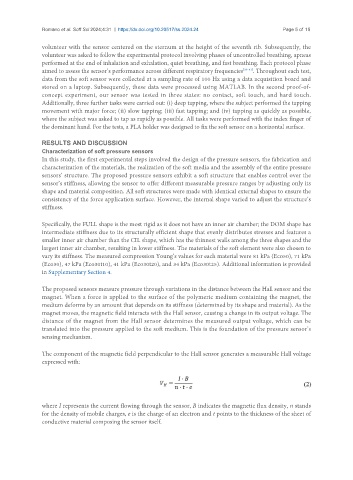
               The component of the magnetic field perpendicular to the Hall sensor generates a measurable Hall voltage
               expressed with:


               where I represents the current flowing through the sensor, B indicates the magnetic flux density, n stands
               for the density of mobile charges, e is the charge of an electron and t points to the thickness of the sheet of
               conductive material composing the sensor itself.

