


Page 13 - Read Online
P. 13
Page 10 of 15                         Romano et al. Soft Sci 2024;4:31  https://dx.doi.org/10.20517/ss.2024.24


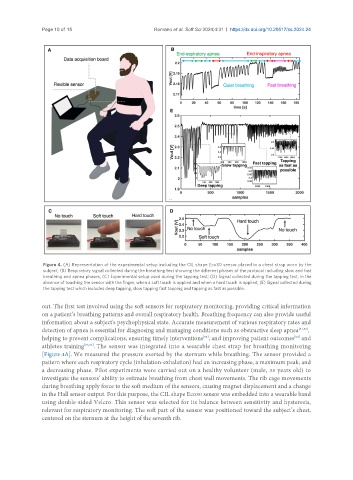
                Figure 4. (A) Representation of the experimental setup including the CIL shape Eco30 sensor placed in a chest strap worn by the
                subject; (B) Respiratory signal collected during the breathing test showing the different phases of the protocol including slow and fast
                breathing and apnea phases; (C) Experimental setup used during the tapping test; (D) Signal collected during the tapping test, in the
                absence of touching the sensor with the finger, when a soft touch is applied and when a hard touch is applied; (E) Signal collected during
                the tapping test which includes deep tapping, slow tapping fast tapping and tapping as fast as possible.


               out. The first test involved using the soft sensors for respiratory monitoring, providing critical information
               on a patient’s breathing patterns and overall respiratory health. Breathing frequency can also provide useful
               information about a subject's psychophysical state. Accurate measurement of various respiratory rates and
               detection of apnea is essential for diagnosing and managing conditions such as obstructive sleep apnea [51,52] ,
                                                                     [53]
                                                                                                    [54]
               helping to prevent complications, ensuring timely interventions , and improving patient outcomes  and
               athletes training [55,56] . The sensor was integrated into a wearable chest strap for breathing monitoring
               [Figure 4A]. We measured the pressure exerted by the sternum while breathing. The sensor provided a
               pattern where each respiratory cycle (inhalation-exhalation) had an increasing phase, a maximum peak, and
               a decreasing phase. Pilot experiments were carried out on a healthy volunteer (male, 35 years old) to
               investigate the sensors’ ability to estimate breathing from chest wall movements. The rib cage movements
               during breathing apply force to the soft medium of the sensors, causing magnet displacement and a change
               in the Hall sensor output. For this purpose, the CIL shape Eco30 sensor was embedded into a wearable band
               using double-sided Velcro. This sensor was selected for its balance between sensitivity and hysteresis,
               relevant for respiratory monitoring. The soft part of the sensor was positioned toward the subject’s chest,
               centered on the sternum at the height of the seventh rib.

