


Page 15 - Read Online
P. 15
Page 12 of 15                         Romano et al. Soft Sci 2024;4:31  https://dx.doi.org/10.20517/ss.2024.24

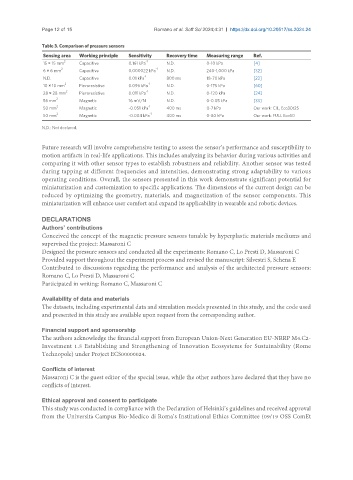
               Table 3. Comparison of pressure sensors
                Sensing area  Working principle  Sensitivity  Recovery time  Measuring range  Ref.
                15 × 15 mm 2  Capacitive    0.161 kPa -1  N.D.         0-10 kPa       [4]
                      2                               -1
                6 × 6 mm    Capacitive      0.000022 kPa  N.D.         240-1,000 kPa  [32]
                                                  -1
                N.D.        Capacitive      0.01 kPa     800 ms        18-70 kPa      [22]
                10 × 10 mm 2  Piezoresistive  0.096 kPa -1  N.D.       0-175 kPa      [60]
                       2                          -1
                28 × 28 mm  Piezoresistive  0.011 kPa    N.D.          0-120 kPa      [24]
                56 mm 2     Magnetic        16 mV/N      N.D.          0-0.05 kPa     [33]
                    2                              -1
                50 mm       Magnetic        -0.051 kPa   400 ms        0-7 kPa        Our work: CIL, Eco30t25
                    2                              -1
                50 mm       Magnetic        -0.004 kPa   400 ms        0-80 kPa       Our work: FULL Eco50
               N.D.: Not declared.


               Future research will involve comprehensive testing to assess the sensor’s performance and susceptibility to
               motion artifacts in real-life applications. This includes analyzing its behavior during various activities and
               comparing it with other sensor types to establish robustness and reliability. Another sensor was tested
               during tapping at different frequencies and intensities, demonstrating strong adaptability to various
               operating conditions. Overall, the sensors presented in this work demonstrate significant potential for
               miniaturization and customization to specific applications. The dimensions of the current design can be
               reduced by optimizing the geometry, materials, and magnetization of the sensor components. This
               miniaturization will enhance user comfort and expand its applicability in wearable and robotic devices.


               DECLARATIONS
               Authors’ contributions
               Conceived the concept of the magnetic pressure sensors tunable by hyperplastic materials mediums and
               supervised the project: Massaroni C
               Designed the pressure sensors and conducted all the experiments: Romano C, Lo Presti D, Massaroni C
               Provided support throughout the experiment process and revised the manuscript: Silvestri S, Schena E
               Contributed to discussions regarding the performance and analysis of the architected pressure sensors:
               Romano C, Lo Presti D, Massaroni C
               Participated in writing: Romano C, Massaroni C

               Availability of data and materials
               The datasets, including experimental data and simulation models presented in this study, and the code used
               and presented in this study are available upon request from the corresponding author.


               Financial support and sponsorship
               The authors acknowledge the financial support from European Union-Next Generation EU-NRRP M4.C2-
               Investment 1.5 Establishing and Strengthening of Innovation Ecosystems for Sustainability (Rome
               Technopole) under Project ECS00000024.

               Conflicts of interest
               Massaroni C is the guest editor of the special issue, while the other authors have declared that they have no
               conflicts of interest.


               Ethical approval and consent to participate
               This study was conducted in compliance with the Declaration of Helsinki’s guidelines and received approval
               from the Università Campus Bio-Medico di Roma’s Institutional Ethics Committee (09/19 OSS ComEt

