


Page 31 - Read Online
P. 31
Wang et al. Soft Sci 2024;4:41  https://dx.doi.org/10.20517/ss.2024.53          Page 13 of 43

               Table 4. Comparison of different types of coating/plating techniques
                Types                    Materials         Substrates      Diameter     Accuracy     Ref.
                Direct dipping coating   P(VDF-TrFE)       Ag wire         100 μm       ~608 nm      [20]
                Suspended shear dipping  PaLMPs; CaLMPs    Fiber           20 μm        -            [95]
                Electrochemical plating  Zn/Ti             Fiber electrodes  500 μm     8 μm / 3 μm  [96]
                In-situ chemical reduction  AgNPs          DCY             639 ± 19 μm  15-19 μm     [41]
                Solution redox           V6O13             CNT             -            -            [97]

               P(VDF-TrFE): Poly(vinylidene fluoride-trifluoroethylene); LMPs: liquid metal particles; AgNPs: silver nanoparticles; DCY: double covered yarn;
               CNT: carbon nanotube.


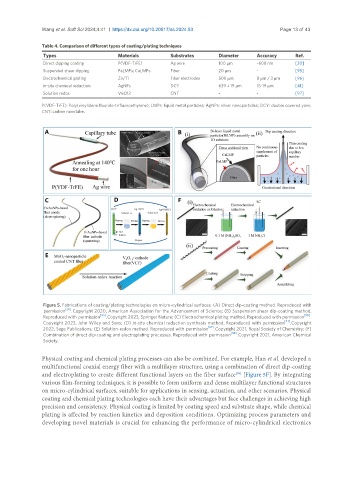
                Figure 5. Fabrications of coating/plating technologies on micro-cylindrical surfaces. (A) Direct dip-coating method. Reproduced with
                permission [20] . Copyright 2020, American Association for the Advancement of Science; (B) Suspension shear dip-coating method.
                Reproduced with permission [95] . Copyright 2023, Springer Nature; (C) Electrochemical plating method. Reproduced with permission [96] .
                Copyright 2023, John Wiley and Sons; (D) In-situ chemical reduction synthesis method. Reproduced with  permission [41] . Copyright
                2022, Sage Publications; (E) Solution-redox method. Reproduced with  permission [97] . Copyright 2021, Royal Society of Chemistry; (F)
                Combination of direct dip-coating and electroplating processes. Reproduced with  permission [98] . Copyright 2021, American Chemical
                Society.


               Physical coating and chemical plating processes can also be combined. For example, Han et al. developed a
               multifunctional coaxial energy fiber with a multilayer structure, using a combination of direct dip-coating
               and electroplating to create different functional layers on the fiber surface  [Figure 5F]. By integrating
                                                                                [98]
               various film-forming techniques, it is possible to form uniform and dense multilayer functional structures
               on micro-cylindrical surfaces, suitable for applications in sensing, actuation, and other scenarios. Physical
               coating and chemical plating technologies each have their advantages but face challenges in achieving high
               precision and consistency. Physical coating is limited by coating speed and substrate shape, while chemical
               plating is affected by reaction kinetics and deposition conditions. Optimizing process parameters and
               developing novel materials is crucial for enhancing the performance of micro-cylindrical electronics

