


Page 29 - Read Online
P. 29
Wang et al. Soft Sci 2024;4:41  https://dx.doi.org/10.20517/ss.2024.53          Page 11 of 43

               Table 3. Comparison of different types of inkjet printing techniques
                Types            Materials              Substrates              Diameter   Accuracy  Ref.
                Inkjet printing  Ag ink (28 cP)         PU fiber substrate      500 μm     133 μm    [15]
                Aerosol jet printing  AgNPs flake ink   PTFE                    2.248 mm   250 μm    [13]
                EHD printing     Ag-PCL mixed ink       Glass and silicon substrates  4 mm  8 ± 0.4 μm  [90]
                                 PCL                    Glass microtubes        1-10 mm    80 μm     [14]
                Electrospinning  Ultrafine polyaniline fibres  -                -          < 5 μm    [89]

               PU: Polyurethane; AgNPs: silver nanoparticles; PTFE: polytetrafluoroethylene; EHD: electrohydrodynamic; PCL: polycaprolactone.


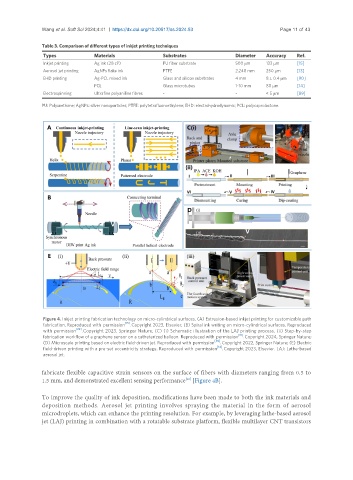
                Figure 4. Inkjet printing fabrication technology on micro-cylindrical surfaces. (A) Extrusion-based inkjet printing for customizable path
                                           [15]
                fabrication. Reproduced with  permission  . Copyright 2023, Elsevier; (B) Spiral ink writing on micro-cylindrical surfaces. Reproduced
                           [29]
                with  permission  . Copyright 2023, Springer Nature; (C) (i) Schematic illustration of the LAJ printing process. (ii) Step-by-step
                                                                                 [91]
                fabrication workflow of a graphene sensor on a catheterized balloon. Reproduced with permission  . Copyright 2024, Springer Nature;
                                                                         [89]
                (D) Microscale printing based on electric field-driven jet. Reproduced with permission  . Copyright 2022, Springer Nature; (E) Electric
                                                                          [14]
                field-driven printing with a pre-set eccentricity strategy. Reproduced with  permission  . Copyright 2023, Elsevier. LAJ: Lathe-based
                aerosol jet.
               fabricate flexible capacitive strain sensors on the surface of fibers with diameters ranging from 0.5 to
                                                                [29]
               1.5 mm, and demonstrated excellent sensing performance  [Figure 4B].
               To improve the quality of ink deposition, modifications have been made to both the ink materials and
               deposition methods. Aerosol jet printing involves spraying the material in the form of aerosol
               microdroplets, which can enhance the printing resolution. For example, by leveraging lathe-based aerosol
               jet (LAJ) printing in combination with a rotatable substrate platform, flexible multilayer CNT transistors

