


Page 26 - Read Online
P. 26
Page 8 of 43                            Wang et al. Soft Sci 2024;4:41  https://dx.doi.org/10.20517/ss.2024.53

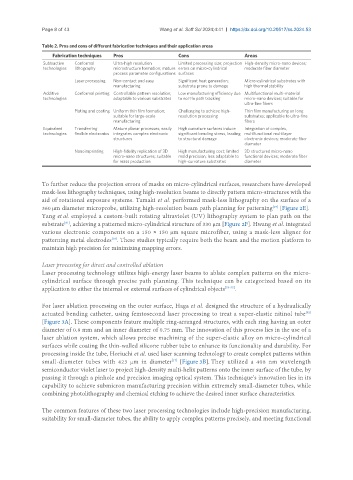
               Table 2. Pros and cons of different fabrication techniques and their application areas
                   Fabrication techniques  Pros              Cons                  Areas
                Subtractive   Conformal   Ultra-high resolution   Limited processing size; projection  High-density micro-nano devices;
                technologies  lithography  microstructure formation; mature  errors on micro-cylindrical   moderate fiber diameter
                                       process parameter configurations surfaces
                          Laser processing  Non-contact and easy   Significant heat generation;   Micro-cylindrical substrates with
                                       manufacturing         substrate prone to damage  high thermal stability
                Additive   Conformal printing Controllable pattern resolution;   Low manufacturing efficiency due  Multifunctional multi-material
                technologies           adaptable to various substrates  to nozzle path tracking  micro-nano devices; suitable for
                                                                                   ultra-fine fibers
                          Plating and coating Uniform thin film formation;   Challenging to achieve high-  Thin film manufacturing on long
                                       suitable for large-scale   resolution processing  substrates; applicable to ultra-fine
                                       manufacturing                               fibers
                Equivalent   Transferring   Mature planar processes; easily   High curvature surfaces induce   Integration of complex,
                technologies  flexible electronics integrates complex electronic   significant bending stress, leading  multifunctional multilayer
                                       structures            to structural damage  electronic devices; moderate fiber
                                                                                   diameter
                          Nanoimprinting  High-fidelity replication of 3D   High manufacturing cost; limited   3D structured micro-nano
                                       micro-nano structures; suitable   mold precision; less adaptable to   functional devices; moderate fiber
                                       for mass production   high-curvature substrates  diameter


               To further reduce the projection errors of masks on micro-cylindrical surfaces, researchers have developed
               mask-less lithography techniques, using high-resolution beams to directly pattern micro-structures with the
               aid of rotational exposure systems. Tamaki et al. performed mask-less lithography on the surface of a
                                                                                             [19]
               360 μm diameter microprobe, utilizing high-resolution beam path planning for patterning  [Figure 2E].
               Yang et al. employed a custom-built rotating ultraviolet (UV) lithography system to plan path on the
                       [81]
               substrate , achieving a patterned micro-cylindrical structure of 330 μm [Figure 2F]. Hwang et al. integrated
               various electronic components on a 150 × 150 μm square microfiber, using a mask-less aligner for
                                       [18]
               patterning metal electrodes . These studies typically require both the beam and the motion platform to
               maintain high precision for minimizing mapping errors.

               Laser processing for direct and controlled ablation
               Laser processing technology utilizes high-energy laser beams to ablate complex patterns on the micro-
               cylindrical surface through precise path planning. This technique can be categorized based on its
               application to either the internal or external surfaces of cylindrical objects [75-77] .


               For laser ablation processing on the outer surface, Haga et al. designed the structure of a hydraulically
                                                                                                        [82]
               actuated bending catheter, using femtosecond laser processing to treat a super-elastic nitinol tube
               [Figure 3A]. These components feature multiple ring-arranged structures, with each ring having an outer
               diameter of 0.8 mm and an inner diameter of 0.75 mm. The innovation of this process lies in the use of a
               laser ablation system, which allows precise machining of the super-elastic alloy on micro-cylindrical
               surfaces while coating the thin-walled silicone rubber tube to enhance its functionality and durability. For
               processing inside the tube, Horiuchi et al. used laser scanning technology to create complex patterns within
               small-diameter tubes with 423  μm in  diameter   [Figure 3B]. They utilized a 408 nm wavelength
                                                           [17]
               semiconductor violet laser to project high-density multi-helix patterns onto the inner surface of the tube, by
               passing it through a pinhole and precision imaging optical system. This technique’s innovation lies in its
               capability to achieve submicron manufacturing precision within extremely small-diameter tubes, while
               combining photolithography and chemical etching to achieve the desired inner surface characteristics.


               The common features of these two laser processing technologies include high-precision manufacturing,
               suitability for small-diameter tubes, the ability to apply complex patterns precisely, and meeting functional

