


Page 23 - Read Online
P. 23
Wang et al. Soft Sci 2024;4:41  https://dx.doi.org/10.20517/ss.2024.53           Page 5 of 43


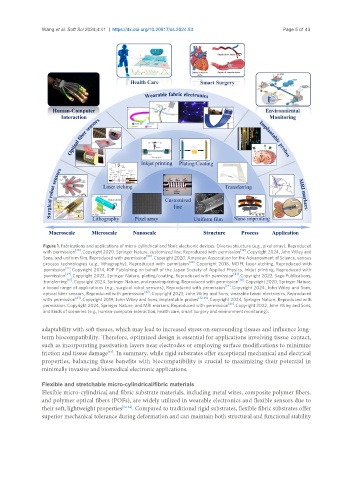
                Figure 1. Fabrications and applications of micro-cylindrical and fibric electronic devices. Diverse structure (e.g., pixel array), Reproduced
                with permission [38] . Copyright 2020, Springer Nature, customized line, Reproduced with permission [39] . Copyright 2024, John Wiley and
                Sons, and uniform film, Reproduced with permission [20] . Copyright 2020, American Association for the Advancement of Science, various
                process technologies (e.g., lithography), Reproduced with  permission [40] . Copyright 2018, MDPI, laser etching, Reproduced with
                permission [17] . Copyright 2014, IOP Publishing on behalf of the Japan Society of Applied Physics, inkjet printing, Reproduced with
                permission [29] . Copyright 2023, Springer Nature, plating/coating, Reproduced with  permission [41] . Copyright 2022, Sage Publications,
                transferring [32] . Copyright 2024, Springer Nature, and nanoimprinting, Reproduced with permission [38] . Copyright 2020, Springer Nature,
                a broad range of applications (e.g., surgical robot sensors), Reproduced with  permission [24] . Copyright 2024, John Wiley and Sons,
                optical fiber sensors, Reproduced with  permission [42] . Copyright 2023, John Wiley and Sons, wearable fabric electronics, Reproduced
                with permission [43] . Copyright 2019, John Wiley and Sons, implantable probes [32,44] . Copyright 2024, Springer Nature, Reproduced with
                permission. Copyright 2024, Springer Nature, and MRI markers, Reproduced with permission [45] . Copyright 2022, John Wiley and Sons,
                and kinds of sceneries (e.g., human-computer interaction, health care, smart surgery and environment monitoring).

               adaptability with soft tissues, which may lead to increased stress on surrounding tissues and influence long-
               term biocompatibility. Therefore, optimized design is essential for applications involving tissue contact,
               such as incorporating passivation layers near electrodes or employing surface modifications to minimize
               friction and tissue damage . In summary, while rigid substrates offer exceptional mechanical and electrical
                                     [51]
               properties, balancing these benefits with biocompatibility is crucial to maximizing their potential in
               minimally invasive and biomedical electronic applications.

               Flexible and stretchable micro-cylindrical/fibric materials
               Flexible micro-cylindrical and fibric substrate materials, including metal wires, composite polymer fibers,
               and polymer optical fibers (POFs), are widely utilized in wearable electronics and flexible sensors due to
               their soft, lightweight properties [52-54] . Compared to traditional rigid substrates, flexible fibric substrates offer
               superior mechanical tolerance during deformation and can maintain both structural and functional stability

