


Page 28 - Read Online
P. 28
Page 10 of 43                           Wang et al. Soft Sci 2024;4:41  https://dx.doi.org/10.20517/ss.2024.53


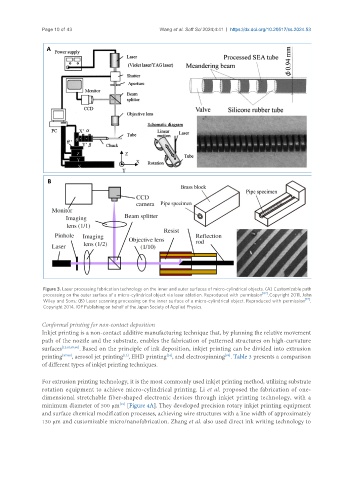
                Figure 3. Laser processing fabrication technology on the inner and outer surfaces of micro-cylindrical objects. (A) Customizable path
                processing on the outer surface of a micro-cylindrical object via laser ablation. Reproduced with  permission [82] . Copyright 2011, John
                Wiley and Sons; (B) Laser scanning processing on the inner surface of a micro-cylindrical object. Reproduced with  permission [17] .
                Copyright 2014, IOP Publishing on behalf of the Japan Society of Applied Physics.


               Conformal printing for non-contact deposition
               Inkjet printing is a non-contact additive manufacturing technique that, by planning the relative movement
               path of the nozzle and the substrate, enables the fabrication of patterned structures on high-curvature
               surfaces [12,83,85,86] . Based on the principle of ink deposition, inkjet printing can be divided into extrusion
                                                         [14]
                                          [13]
               printing [87,88] , aerosol jet printing , EHD printing , and electrospinning . Table 3 presents a comparison
                                                                             [89]
               of different types of inkjet printing techniques.
               For extrusion printing technology, it is the most commonly used inkjet printing method, utilizing substrate
               rotation equipment to achieve micro-cylindrical printing. Li et al. proposed the fabrication of one-
               dimensional stretchable fiber-shaped electronic devices through inkjet printing technology, with a
                                         [15]
               minimum diameter of 500 μm  [Figure 4A]. They developed precision rotary inkjet printing equipment
               and surface chemical modification processes, achieving wire structures with a line width of approximately
               130 μm and customizable micro/nanofabrication. Zhang et al. also used direct ink writing technology to

