


Page 33 - Read Online
P. 33
Wang et al. Soft Sci 2024;4:41  https://dx.doi.org/10.20517/ss.2024.53          Page 15 of 43


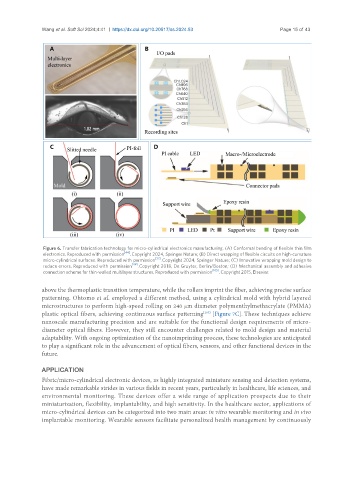
                Figure 6. Transfer fabrication technology for micro-cylindrical electronics manufacturing. (A) Conformal bending of flexible thin film
                                           [44]
                electronics. Reproduced with permission  . Copyright 2024, Springer Nature; (B) Direct wrapping of flexible circuits on high-curvature
                                                     [32]
                micro-cylindrical surfaces. Reproduced with  permission  . Copyright 2024, Springer Nature; (C) Innovative wrapping mold design to
                                             [49]
                reduce errors. Reproduced with  permission  . Copyright 2018, De Gruyter, Berlin/Boston; (D) Mechanical assembly and adhesive
                connection scheme for thin-walled multilayer structures. Reproduced with permission [105] . Copyright 2015, Elsevier.
               above the thermoplastic transition temperature, while the rollers imprint the fiber, achieving precise surface
               patterning. Ohtomo et al. employed a different method, using a cylindrical mold with hybrid layered
               microstructures to perform high-speed rolling on 240 μm diameter polymenthylmethacrylate (PMMA)
               plastic optical fibers, achieving continuous surface patterning  [Figure 7C]. These techniques achieve
                                                                      [107]
               nanoscale manufacturing precision and are suitable for the functional design requirements of micro-
               diameter optical fibers. However, they still encounter challenges related to mold design and material
               adaptability. With ongoing optimization of the nanoimprinting process, these technologies are anticipated
               to play a significant role in the advancement of optical fibers, sensors, and other functional devices in the
               future.

               APPLICATION
               Fibric/micro-cylindrical electronic devices, as highly integrated miniature sensing and detection systems,
               have made remarkable strides in various fields in recent years, particularly in healthcare, life sciences, and
               environmental monitoring. These devices offer a wide range of application prospects due to their
               miniaturization, flexibility, implantability, and high sensitivity. In the healthcare sector, applications of
               micro-cylindrical devices can be categorized into two main areas: in vitro wearable monitoring and in vivo
               implantable monitoring. Wearable sensors facilitate personalized health management by continuously

