


Page 34 - Read Online
P. 34
Page 16 of 43                           Wang et al. Soft Sci 2024;4:41  https://dx.doi.org/10.20517/ss.2024.53


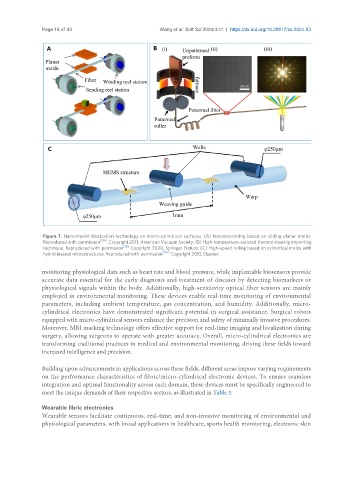
                Figure 7. Nanoimprint fabrication technology on micro-cylindrical surfaces. (A) Nanoimprinting based on sliding planar molds.
                Reproduced with permission [106] . Copyright 2011, American Vacuum Society; (B) High-temperature-assisted thermal drawing imprinting
                technique. Reproduced with  permission [38] . Copyright 2020, Springer Nature; (C) High-speed rolling based on cylindrical molds with
                hybrid layered microstructures. Reproduced with permission [107] . Copyright 2013, Elsevier.

               monitoring physiological data such as heart rate and blood pressure, while implantable biosensors provide
               accurate data essential for the early diagnosis and treatment of diseases by detecting biomarkers or
               physiological signals within the body. Additionally, high-sensitivity optical fiber sensors are mainly
               employed in environmental monitoring. These devices enable real-time monitoring of environmental
               parameters, including ambient temperature, gas concentration, and humidity. Additionally, micro-
               cylindrical electronics have demonstrated significant potential in surgical assistance. Surgical robots
               equipped with micro-cylindrical sensors enhance the precision and safety of minimally invasive procedures.
               Moreover, MRI marking technology offers effective support for real-time imaging and localization during
               surgery, allowing surgeons to operate with greater accuracy. Overall, micro-cylindrical electronics are
               transforming traditional practices in medical and environmental monitoring, driving these fields toward
               increased intelligence and precision.


               Building upon advancements in applications across these fields, different areas impose varying requirements
               on the performance characteristics of fibric/micro-cylindrical electronic devices. To ensure seamless
               integration and optimal functionality across each domain, these devices must be specifically engineered to
               meet the unique demands of their respective sectors, as illustrated in Table 5.

               Wearable fibric electronics
               Wearable sensors facilitate continuous, real-time, and non-invasive monitoring of environmental and
               physiological parameters, with broad applications in healthcare, sports health monitoring, electronic skin

