


Page 35 - Read Online
P. 35
Wang et al. Soft Sci 2024;4:41  https://dx.doi.org/10.20517/ss.2024.53          Page 17 of 43

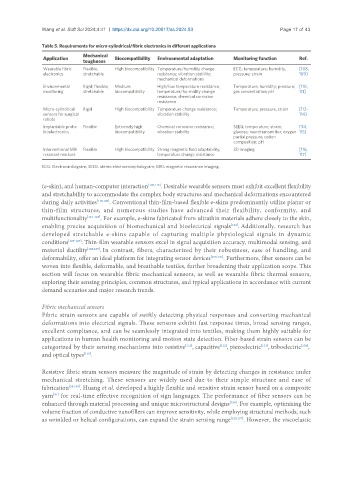
               Table 5. Requirements for micro-cylindrical/fibric electronics in different applications
                             Mechanical
                Application             Biocompatibility  Environmental adaptation  Monitoring function  Ref.
                             toughness
                Wearable fibric   Flexible;   High biocompatibility Temperature/humidity change   ECG; temperature; humidity;   [108,
                electronics  stretchable              resistance; vibration stability;   pressure; strain  109]
                                                      mechanical deformations
                Environmental   Rigid; flexible;   Medium   High/low temperature resistance;   Temperature; humidity; pressure;  [110,
                monitoring   stretchable  biocompatibility  temperature/hu-midity change   gas concentration; pH  111]
                                                      resistance; chemical corrosion
                                                      resistance
                Micro-cylindrical   Rigid  High biocompatibility Temperature change resistance;   Temperature; pressure; strain  [112-
                sensors for surgical                  vibration stability                             114]
                robots
                Implantable probe   Flexible  Extremely high   Chemical corrosion resistance;   SEEG; temperature; strain;   [34,
                bioelectronics          biocompatibility  vibration stability   glucose; neurotransmitter; oxygen  115]
                                                                                partial pressure; cation
                                                                                composition; pH
                Interventional MRI   Flexible  High biocompatibility Strong magnetic field adaptability;   3D imaging  [116,
                resonant markers                      temperature change resistance                   117]

               ECG: Electrocardiogram; SEEG: stereo electroencephalogram; MRI: magnetic resonance imaging.

               (e-skin), and human-computer interaction [108,118] . Desirable wearable sensors must exhibit excellent flexibility
               and stretchability to accommodate the complex body structures and mechanical deformations encountered
               during daily activities [119,120] . Conventional thin-film-based flexible e-skins predominantly utilize planar or
               thin-film  structures,  and  numerous  studies  have  advanced  their  flexibility,  conformity,  and
               multifunctionality [121-123] . For example, e-skins fabricated from ultrathin materials adhere closely to the skin,
               enabling precise acquisition of biomechanical and bioelectrical signals . Additionally, research has
                                                                               [124]
               developed  stretchable  e-skins  capable  of  capturing  multiple  physiological  signals  in  dynamic
               conditions [125-127] . Thin-film wearable sensors excel in signal acquisition accuracy, multimodal sensing, and
               material ductility [128,129] . In contrast, fibers, characterized by their robustness, ease of handling, and
               deformability, offer an ideal platform for integrating sensor devices [109,130] . Furthermore, fiber sensors can be
               woven into flexible, deformable, and breathable textiles, further broadening their application scope. This
               section will focus on wearable fibric mechanical sensors, as well as wearable fibric thermal sensors,
               exploring their sensing principles, common structures, and typical applications in accordance with current
               demand scenarios and major research trends.


               Fibric mechanical sensors
               Fibric strain sensors are capable of swiftly detecting physical responses and converting mechanical
               deformations into electrical signals. These sensors exhibit fast response times, broad sensing ranges,
               excellent compliance, and can be seamlessly integrated into textiles, making them highly suitable for
               applications in human health monitoring and motion state detection. Fiber-based strain sensors can be
               categorized by their sensing mechanisms into resistive , capacitive , piezoelectric , triboelectric ,
                                                                           [132]
                                                                                         [133]
                                                                                                       [134]
                                                               [131]
               and optical types .
                             [135]
               Resistive fibric strain sensors measure the magnitude of strain by detecting changes in resistance under
               mechanical stretching. These sensors are widely used due to their simple structure and ease of
               fabrication [58,108] . Huang et al. developed a highly flexible and sensitive strain sensor based on a composite
               yarn  for real-time effective recognition of sign languages. The performance of fiber sensors can be
                   [41]
               enhanced through material processing and unique microstructural designs . For example, optimizing the
                                                                              [136]
               volume fraction of conductive nanofillers can improve sensitivity, while employing structural methods, such
               as wrinkled or helical configurations, can expand the strain sensing range [120,137] . However, the viscoelastic

