


Page 27 - Read Online
P. 27
Wang et al. Soft Sci 2024;4:41  https://dx.doi.org/10.20517/ss.2024.53           Page 9 of 43


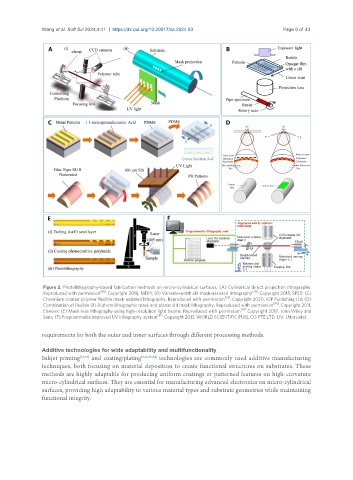
                Figure 2. Photolithography-based fabrication methods on micro-cylindrical surfaces. (A) Cylindrical direct projection lithography.
                Reproduced with permission [40] . Copyright 2018, MDPI; (B) Variable-width slit mask-assisted lithography [78] . Copyright 2015, SPST; (C)
                Chromium-coated polymer flexible mask-assisted lithography. Reproduced with permission [79] . Copyright 2020, IOP Publishing Ltd; (D)
                Combination of flexible SU-8 photolithographic mask and planar slit mask lithography. Reproduced with permission [80] . Copyright 2011,
                                                                                  [19]
                Elsevier; (E) Mask-less lithography using high-resolution light beams. Reproduced with permission  . Copyright 2017, John Wiley and
                                                      [81]
                Sons; (F) Programmable improved UV lithography system  . Copyright 2013, WORLD SCIENTIFIC PUBL CO PTE LTD. UV: Ultraviolet.
               requirements for both the outer and inner surfaces through different processing methods.

               Additive technologies for wide adaptability and multifunctionality
               Inkjet printing [16,83]  and coating/plating [9,10,56,84]  technologies are commonly used additive manufacturing
               techniques, both focusing on material deposition to create functional structures on substrates. These
               methods are highly adaptable for producing uniform coatings or patterned features on high-curvature
               micro-cylindrical surfaces. They are essential for manufacturing advanced electronics on micro-cylindrical
               surfaces, providing high adaptability to various material types and substrate geometries while maintaining
               functional integrity.

