


Page 160 - Read Online
P. 160
Wang et al. Soft Sci. 2025, 5, 28  https://dx.doi.org/10.20517/ss.2025.11       Page 11 of 29


                                                                                                   2
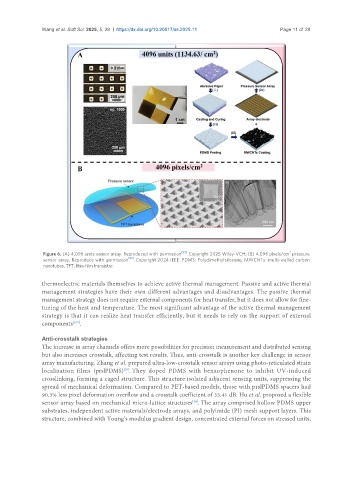
                Figure 6. (A) 4,096 units sensor array. Reproduced with  permission [93] . Copyright 2025 Wiley-VCH; (B) 4,096 pixels/cm  pressure
                sensor array. Reproduce with  permission [30] . Copyright 2024 IEEE. PDMS: Polydimethylsiloxane; MWCNTs: multi-walled carbon
                nanotubes; TFT: thin-film transistor.

               thermoelectric materials themselves to achieve active thermal management. Passive and active thermal
               management strategies have their own different advantages and disadvantages. The passive thermal
               management strategy does not require external components for heat transfer, but it does not allow for fine-
               tuning of the heat and temperature. The most significant advantage of the active thermal management
               strategy is that it can realize heat transfer efficiently, but it needs to rely on the support of external
               components .
                          [100]

               Anti-crosstalk strategies
               The increase in array channels offers more possibilities for precision measurement and distributed sensing
               but also increases crosstalk, affecting test results. Thus, anti-crosstalk is another key challenge in sensor
               array manufacturing. Zhang et al. prepared ultra-low-crosstalk sensor arrays using photo-reticulated strain
                                           [35]
               localization  films  (prslPDMS) . They  doped  PDMS  with  benzophenone  to  inhibit  UV-induced
               crosslinking, forming a caged structure. This structure isolated adjacent sensing units, suppressing the
               spread of mechanical deformation. Compared to PET-based models, those with prslPDMS spacers had
               90.3% less pixel deformation overflow and a crosstalk coefficient of 33.41 dB. Hu et al. proposed a flexible
               sensor array based on mechanical micro-lattice structures . The array comprised hollow PDMS upper
                                                                  [34]
               substrates, independent active materials/electrode arrays, and polyimide (PI) mesh support layers. This
               structure, combined with Young’s modulus gradient design, concentrated external forces on stressed units,

