


Page 165 - Read Online
P. 165
Page 16 of 29                          Wang et al. Soft Sci. 2025, 5, 28  https://dx.doi.org/10.20517/ss.2025.11


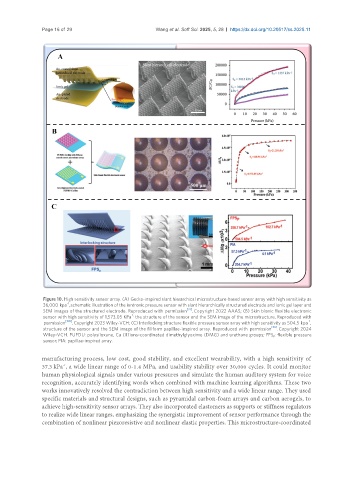
                Figure 10. High sensitivity sensor array. (A) Gecko-inspired slant hierarchical microstructure-based sensor array with high sensitivity as
                        -1
                36,000 kpa , schematic illustration of the iontronic pressure sensor with slant hierarchically structured electrode and ionic gel layer and
                SEM images of the structured electrode. Reproduced with  permission [37] . Copyright 2022 AAAS; (B) Skin bionic flexible electronic
                                             -1,
                sensor with high sensitivity of 1,573.05 KPa  the structure of the sensor and the SEM image of the microstructure. Reproduced with
                                                                                                         -1
                permission [105] . Copyright 2023 Wiley-VCH; (C) Interlocking structure flexible pressure sensor array with high sensitivity as 504.5 kpa ,
                structure of the sensor and the SEM image of the filiform papillae-inspired array. Reproduced with  permission [36] . Copyright 2024
                Wiley-VCH. PUPDU: polysiloxane, Cu (II)ions-coordinated dimethylglyoxime (DMG) and urethane groups; FPS : flexible pressure
                                                                                             P
                sensor; PIA: papillae-inspired array.
               manufacturing process, low cost, good stability, and excellent wearability, with a high sensitivity of
               37.3 kPa , a wide linear range of 0-1.4 MPa, and usability stability over 30,000 cycles. It could monitor
                      -1
               human physiological signals under various pressures and simulate the human auditory system for voice
               recognition, accurately identifying words when combined with machine learning algorithms. These two
               works innovatively resolved the contradiction between high sensitivity and a wide linear range. They used
               specific materials and structural designs, such as pyramidal carbon-foam arrays and carbon aerogels, to
               achieve high-sensitivity sensor arrays. They also incorporated elastomers as supports or stiffness regulators
               to realize wide linear ranges, emphasizing the synergistic improvement of sensor performance through the
               combination of nonlinear piezoresistive and nonlinear elastic properties. This microstructure-coordinated

