


Page 168 - Read Online
P. 168
Wang et al. Soft Sci. 2025, 5, 28  https://dx.doi.org/10.20517/ss.2025.11       Page 19 of 29


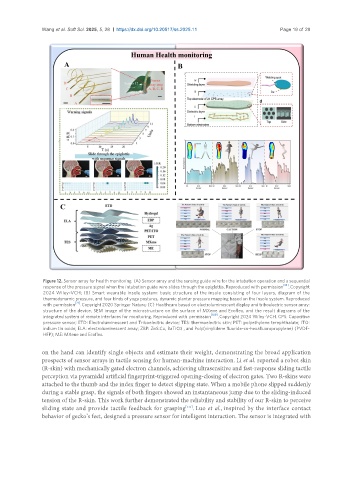
                Figure 12. Sensor array for health monitoring. (A) Sensor array and the sensing guide wire for the intubation operation and a sequential
                                                                                                [33]
                response of the pressure signal when the intubation guide wire slides through the epiglottis. Reproduced with permission  . Copyright
                2024 Wiley-VCH; (B) Smart wearable insole system: basic structure of the insole consisting of four layers, diagram of the
                thermodynamic pressure, and four kinds of yoga postures, dynamic plantar pressure mapping based on the insole system. Reproduced
                          [21]
                with permission  . Copyright 2020 Springer Nature; (C) Healthcare based on electroluminescent display and triboelectric sensor array:
                structure of the device, SEM image of the microstructure on the surface of MXene and Ecoflex, and the result diagrams of the
                                                                        [109]
                integrated system of remote interfaces for monitoring. Reproduced with permission  . Copyright 2024 Wiley-VCH. CPS: Capacitive
                pressure sensor; ETD: Electroluminescent and Triboelectric device; TES: thermoelectric skin; PET: polyethylene terephthalate; ITO:
                indium tin oxide; ELA: electroluminescent array; ZBP: ZnS:Cu, BaTiO3 , and Poly(vinylidene fluoride-co-hexafluoropropylene) (PVDF-
                HFP); ME: MXene and Ecoflex.
               on the hand can identify single objects and estimate their weight, demonstrating the broad application
               prospects of sensor arrays in tactile sensing for human-machine interaction. Li et al. reported a robot skin
               (R-skin) with mechanically gated electron channels, achieving ultrasensitive and fast-response sliding tactile
               perception via pyramidal artificial fingerprint-triggered opening-closing of electron gates. Two R-skins were
               attached to the thumb and the index finger to detect slipping state. When a mobile phone slipped suddenly
               during a stable grasp, the signals of both fingers showed an instantaneous jump due to the sliding-induced
               tension of the R-skin. This work further demonstrated the reliability and stability of our R-skin to perceive
                                                                [111]
               sliding state and provide tactile feedback for grasping . Luo et al., inspired by the interface contact
               behavior of gecko’s feet, designed a pressure sensor for intelligent interaction. The sensor is integrated with

