


Page 169 - Read Online
P. 169
Page 20 of 29                          Wang et al. Soft Sci. 2025, 5, 28  https://dx.doi.org/10.20517/ss.2025.11


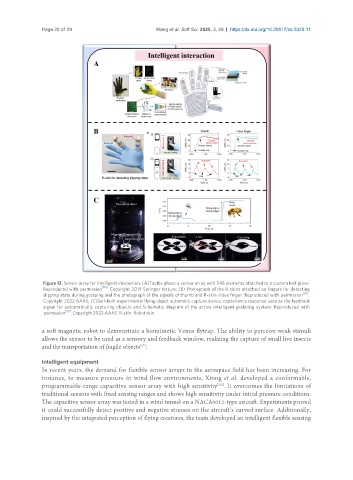
                Figure 13. Sensor array for intelligent interaction. (A)Tactile glove: a sensor array with 548 elements attached to a custom knit glove.
                Reproduced with  permission [110] . Copyright 2019 Springer Nature; (B) Photograph of the R-skins attached on fingers for detecting
                slipping state during grasping and the photograph of the signals of thumb and R-skin index finger. Reproduced with  permission [111] .
                Copyright 2022 AAAS; (C)Self-built experimental flying object automatic capture device; capacitance response used as the feedback
                signal for automatically capturing objects and Schematic diagram of the active intelligent grabbing system. Reproduced with
                       [37]
                permission  . Copyright 2022 AAAS. R-skin: Robot skin.

               a soft magnetic robot to demonstrate a biomimetic Venus flytrap. The ability to perceive weak stimuli
               allows the sensor to be used as a sensory and feedback window, realizing the capture of small live insects
                                                [37]
               and the transportation of fragile objects .

               Intelligent equipment
               In recent years, the demand for flexible sensor arrays in the aerospace field has been increasing. For
               instance, to measure pressure in wind flow environments, Xiong et al. developed a conformable,
               programmable-range capacitive sensor array with high sensitivity . It overcomes the limitations of
                                                                          [112]
               traditional sensors with fixed sensing ranges and shows high sensitivity under initial pressure conditions.
               The capacitive sensor array was tested in a wind tunnel on a NACA0012-type aircraft. Experiments proved
               it could successfully detect positive and negative stresses on the aircraft’s curved surface. Additionally,
               inspired by the integrated perception of flying creatures, the team developed an intelligent flexible sensing

