


Page 173 - Read Online
P. 173
Page 24 of 29                          Wang et al. Soft Sci. 2025, 5, 28  https://dx.doi.org/10.20517/ss.2025.11


               In addition, future flexible sensor arrays must realize self-calibration, self-learning, and self-adaptation. On
               the one hand, the integration of online self-calibration mechanisms helps to compensate for errors caused
               by long-term sensor drift or environmental changes. On the other hand, the introduction of advanced
               algorithms can enable the sensor to adapt to individual differences and the diversity of the usage
               environment, and enhance the universality and extensibility of the system.


               (3) Industrialization and standardization

               Flexible  sensor  arrays  have  seen  many  breakthroughs  in  laboratory  research,  but  large-scale
               commercialization requires further optimization. First, in terms of large-scale manufacturing, the current
               mainstream laboratory preparation methods, such as scratch coating, transfer printing, and laser etching,
               are still difficult to meet the industrial demand for high consistency, and low cost. In the future, we should
               focus on the development of scalable processing technologies, such as flexible printing, and other processes,
               which can take into account the accuracy and capacity, and are suitable for large-scale manufacturing of
               various flexible substrates. At the same time, it is necessary to focus on packaging and integration processes
               to support the integration of complex array structures and integrated components. The current lack of
               unified performance evaluation standards is one of the barriers to realizing the industrialization of sensors.
               Different research organizations tend to use self-made test platforms, resulting in a lack of comparability
               and reproducibility of results. Therefore, in the future, we should promote the development of unified
               standards covering key indicators such as sensitivity, response time, stability, flexibility, durability, and
               environmental adaptability. In addition, taking into account the special needs in wearable applications and
               other fields, application-oriented tests should also be established in the future, such as dynamic response
               testing in real-world environments, stability evaluation after multiple bends, and durability testing in
               different environments. This will not only help improve the reliability of the device, but also accelerate the
               industrialization of the use of sensor parts.


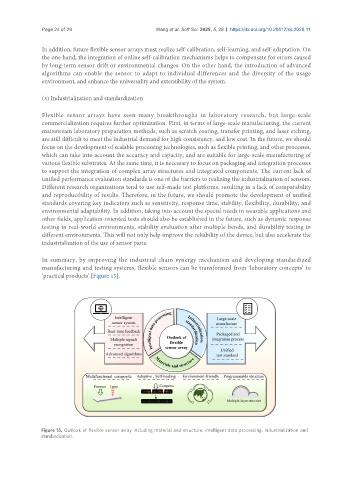
               In summary, by improving the industrial chain synergy mechanism and developing standardized
               manufacturing and testing systems, flexible sensors can be transformed from ‘laboratory concepts’ to
               ‘practical products’ [Figure 15].


               Figure 15. Outlook of flexible sensor array including material and structure, intelligent data processing, industrialization and
               standardization.

