


Page 163 - Read Online
P. 163
Page 14 of 29                          Wang et al. Soft Sci. 2025, 5, 28  https://dx.doi.org/10.20517/ss.2025.11


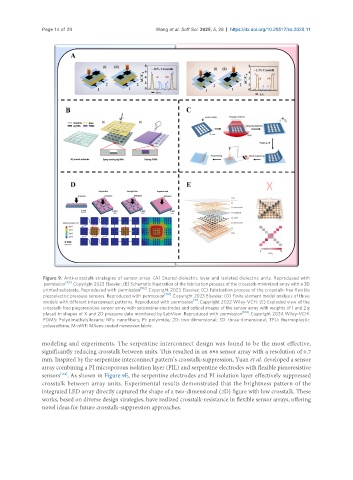
                Figure 9. Anti-crosstalk strategies of sensor array. (A) Shared dielectric layer and isolated dielectric units. Reproduced with
                permission [101] . Copyright 2023 Elsevier; (B) Schematic illustration of the fabrication process of the crosstalk-minimized array with a 3D
                printed substrate. Reproduced with  permission [102] . Copyright 2023 Elsevier; (C) Fabrication process of the crosstalk-free flexible
                piezoelectric pressure sensors. Reproduced with  permission [103] . Copyright 2023 Elsevier; (D) Finite element model analysis of three
                models with different interconnect patterns. Reproduced with  permission [31] . Copyright 2022 Wiley-VCH; (E) Exploded view of the
                crosstalk-free piezoresistive sensor array with serpentine electrodes and optical images of the sensor array with weights of 1 and 2 g
                placed in shapes of X and 2D pressure data monitored by LabView. Reproduced with  permission [104] . Copyright 2024 Wiley-VCH.
                PDMS: Polydimethylsiloxane; NFs: nanofibers; PI: polyimide; 2D: two-dimensional; 3D: three-dimensional; TPU: thermoplastic
                polyurethane; M-nWF: MXene coated nonwoven fabric.


               modeling and experiments. The serpentine interconnect design was found to be the most effective,
               significantly reducing crosstalk between units. This resulted in an 8×8 sensor array with a resolution of 0.7
               mm. Inspired by the serpentine interconnect pattern’s crosstalk-suppression, Yuan et al. developed a sensor
               array combining a PI microporous isolation layer (PIL) and serpentine electrodes with flexible piezoresistive
               sensors . As shown in Figure 9E, the serpentine electrodes and PI isolation layer effectively suppressed
                     [104]
               crosstalk between array units. Experimental results demonstrated that the brightness pattern of the
               integrated LED array directly captured the shape of a two-dimensional (2D) figure with low crosstalk. These
               works, based on diverse design strategies, have realized crosstalk-resistance in flexible sensor arrays, offering
               novel ideas for future crosstalk-suppression approaches.

