


Page 122 - Read Online
P. 122
Keum et al. Soft Sci 2024;4:34  https://dx.doi.org/10.20517/ss.2024.26          Page 15 of 32


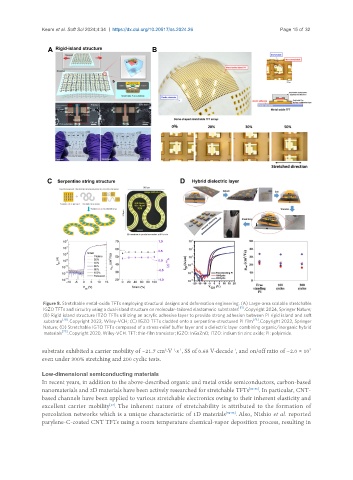
                Figure 8. Stretchable metal-oxide TFTs employing structural designs and deformation engineering. (A) Large-area scalable stretchable
                IGZO TFTs and circuitry using a dual-island structure on molecular-tailored elastomeric substrates [81] . Copyright 2024, Springer Nature;
                (B) Rigid island structure ITZO TFTs utilizing an acrylic adhesive layer to provide strong adhesion between PI rigid island and soft
                      [78]                                                            [79]
                substrate  . Copyright 2022, Wiley-VCH; (C) IGZO TFTs cladded onto a serpentine-structured PI  film  . Copyright 2022, Springer
                Nature; (D) Stretchable IGTO TFTs composed of a stress-relief buffer layer and a dielectric layer combining organic/inorganic hybrid
                      [73]
                materials  . Copyright 2020, Wiley-VCH. TFT: thin-film transistor; IGZO: InGaZnO; ITZO: indium tin zinc oxide; PI: polyimide.
               substrate exhibited a carrier mobility of ~21.7 cm ·V ·s , SS of 0.68 V·decade , and on/off ratio of ~2.0 × 10
                                                         2
                                                                                -1
                                                                                                         7
                                                           -1 -1
               even under 300% stretching and 200 cyclic tests.
               Low-dimensional semiconducting materials
               In recent years, in addition to the above-described organic and metal oxide semiconductors, carbon-based
               nanomaterials and 2D materials have been actively researched for stretchable TFTs [82-86] . In particular, CNT-
               based channels have been applied to various stretchable electronics owing to their inherent elasticity and
               excellent carrier mobility . The inherent nature of stretchability is attributed to the formation of
                                      [13]
               percolation networks which is a unique characteristic of 1D materials [94-96] . Also, Nishio et al. reported
               parylene-C-coated CNT TFTs using a room temperature chemical-vapor deposition process, resulting in

