


Page 125 - Read Online
P. 125
Page 18 of 32                           Keum et al. Soft Sci 2024;4:34  https://dx.doi.org/10.20517/ss.2024.26


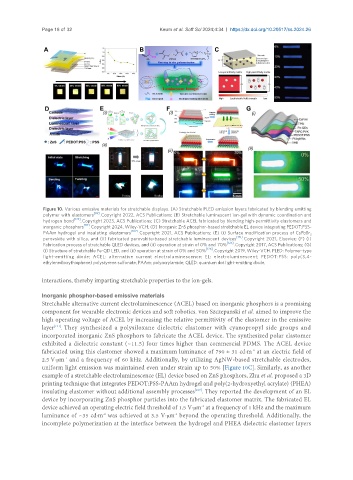
                Figure 10. Various emissive materials for stretchable displays. (A) Stretchable PLED emission layers fabricated by blending emitting
                                 [99]
                polymer with  elastomers  . Copyright 2022, ACS Publications; (B) Stretchable luminescent ion-gel with dynamic coordination and
                          [123]
                hydrogen  bond  . Copyright 2023, ACS Publications; (C) Stretchable ACEL fabricated by blending high-permittivity elastomers and
                             [111]
                inorganic phosphors  . Copyright 2024, Wiley-VCH; (D) Inorganic ZnS phosphor-based stretchable EL device integrating PEDOT:PSS-
                                             [107]
                PAAm hydrogel and insulating  elastomers  . Copyright 2021, ACS Publications; (E) (i) Surface modification process of CsPbBr
                                                                                                          3
                                                                                 [115]
                perovskite with silica, and (ii) fabricated perovskite-based stretchable luminescent  devices  . Copyright 2021, Elsevier; (F) (i)
                                                                              [125]
                Fabrication process of stretchable QLED devices, and (ii) operation at strain of 0% and 70%  . Copyright 2017, ACS Publications; (G)
                                                                      [126]
                (i) Structure of stretchable Pe-QD LED, and (ii) operation at strain of 0% and 50%  . Copyright 2019, Wiley-VCH. PLED: Polymer-type
                light-emitting  diode;  ACEL:  alternative  current  electroluminescence;  EL:  electroluminescent;  PEDOT:PSS:  poly(3,4-
                ethylenedioxythiophene) polystyrene sulfonate; PAAm: polyacrylamide; QLED: quantum dot light-emitting diode.
               interactions, thereby imparting stretchable properties to the ion-gels.
               Inorganic phosphor-based emissive materials
               Stretchable alternative current electroluminescence (ACEL) based on inorganic phosphors is a promising
               component for wearable electronic devices and soft robotics. von Szczepanski et al. aimed to improve the
               high operating voltage of ACEL by increasing the relative permittivity of the elastomer in the emissive
                   [111]
               layer . They synthesized a polysiloxane dielectric elastomer with cyanopropyl side groups and
               incorporated inorganic ZnS phosphors to fabricate the ACEL device. The synthesized polar elastomer
               exhibited a dielectric constant (~11.5) four times higher than commercial PDMS. The ACEL device
               fabricated using this elastomer showed a maximum luminance of 790 ± 31 cd·m  at an electric field of
                                                                                      -2
                       -1
               2.5 V·μm  and a frequency of 60 kHz. Additionally, by utilizing AgNW-based stretchable electrodes,
               uniform light emission was maintained even under strain up to 50% [Figure 10C]. Similarly, as another
               example of a stretchable electroluminescence (EL) device based on ZnS phosphors, Zhu et al. proposed a 3D
               printing technique that integrates PEDOT:PSS-PAAm hydrogel and poly(2-hydroxyethyl acrylate) (PHEA)
               insulating elastomer without additional assembly processes . They reported the development of an EL
                                                                   [107]
               device by incorporating ZnS phosphor particles into the fabricated elastomer matrix. The fabricated EL
               device achieved an operating electric field threshold of 1.5 V·μm  at a frequency of 1 kHz and the maximum
                                                                     -1
               luminance of ~35 cd·m  was achieved at 3.5 V·μm  beyond the operating threshold. Additionally, the
                                    -2
                                                            -1
               incomplete polymerization at the interface between the hydrogel and PHEA dielectric elastomer layers

