


Page 127 - Read Online
P. 127
Page 20 of 32                           Keum et al. Soft Sci 2024;4:34  https://dx.doi.org/10.20517/ss.2024.26

               Table 3. Comparison of light-emitting types, colors, stretchability, maximum brightness, and turn-on voltage of stretchable light-
               emitting devices
                Light-emitting   EML materials (color)  Stretchability   Max. Brightness  Turn-on voltage  Ref.
                                                                       2
                type                                 (%)           (cd/m )           (V)
                PLED          PDY-132 (yellow)       100%          7,450             -              [99]
                OLED          PTrz-tBuCz/TPA-AQ (red)  125%        2,175             4.75           [101]
                              PDKCD (green)
                              PTrz-tBuCz (blue)
                PLED          Spiro-red/SEBS (red)   100%          1,000             5              [97]
                              Spiro-green/SEBS (green)
                              PFO/SEBS (blue)
                OLED          PVK/Hex-Ir(phq)  (red)   100%        5,400             -              [100]
                                         3
                              PVK/Ir(ppy)  (green)
                                      3
                              PVK/Flrpic (blue)
                QLED          CdSe/ZnS QDs (red, green, and   50%  15,170            3.2            [119]
                              blue)
                Pe-QD LED     MAPbBr  QDs (green)    50%           3,187             3.2            [126]
                                   3
               EML: Emitting layer; SS: subthreshold swing; PLED: polymer-type light-emitting diode; PDY-132: Super Yellow (SY); OLED: organic light-emitting
               diode; PTrz-tBuCz/TPA-AQ, PDKCD, PTrz-tBuCz: thermally activated delayed fluorescence (TADF) polymers; SEBS: styrene-ethylene-butylene-
               styrene; PFO: poly(9,9-di-n-octylfluorenyl-2,7-diyl); PVK: poly(9-vinyl carbazole); Flrpic: bis[2-(4,6-difluorophenyl)pyridinato-C2,N]-
               (picolinato)iridium(III); Hex-Ir(phq) : tris[2-(4-n-hexylphenyl)-quinoline]iridium(III); Ir(ppy) : tris(2-phenylpyridine)iridium(III); QD: quantum
                                                                          3
                                      3
               dot.


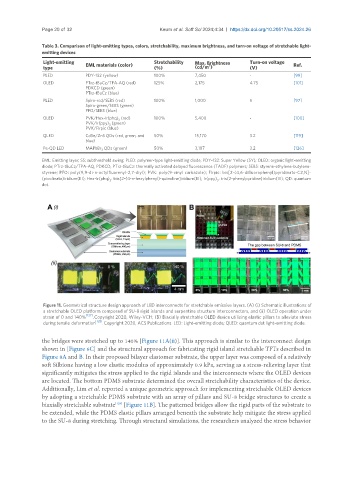
                Figure 11. Geometrical structure design approach of LED interconnects for stretchable emissive layers. (A) (i) Schematic illustrations of
                a stretchable OLED platform composed of SU-8 rigid islands and serpentine structure interconnectors, and (ii) OLED operation under
                              [127]
                strain of 0 and  140%  . Copyright 2020, Wiley-VCH; (B) Biaxially stretchable OLED device utilizing elastic pillars to alleviate stress
                                 [128]
                during tensile deformation  . Copyright 2020, ACS Publications. LED: Light-emitting diode; QLED: quantum dot light-emitting diode.
               the bridges were stretched up to 140% [Figure 11A(ii)]. This approach is similar to the interconnect design
               shown in [Figure 6C] and the structural approach for fabricating rigid island stretchable TFTs described in
               Figure 8A and B. In their proposed bilayer elastomer substrate, the upper layer was composed of a relatively
               soft Silbione having a low elastic modulus of approximately 0.9 kPa, serving as a stress-relieving layer that
               significantly mitigates the stress applied to the rigid islands and the interconnects where the OLED devices
               are located. The bottom PDMS substrate determined the overall stretchability characteristics of the device.
               Additionally, Lim et al. reported a unique geometric approach for implementing stretchable OLED devices
               by adopting a stretchable PDMS substrate with an array of pillars and SU-8 bridge structures to create a
                                        [128]
               biaxially stretchable substrate  [Figure 11B]. The patterned bridges allow the rigid parts of the substrate to
               be extended, while the PDMS elastic pillars arranged beneath the substrate help mitigate the stress applied
               to the SU-8 during stretching. Through structural simulations, the researchers analyzed the stress behavior

