


Page 129 - Read Online
P. 129
Page 22 of 32                           Keum et al. Soft Sci 2024;4:34  https://dx.doi.org/10.20517/ss.2024.26


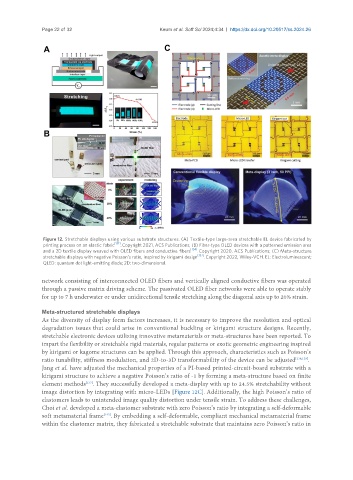
                Figure 12. Stretchable displays using various substrate structures. (A) Textile-type large-area stretchable EL device fabricated by
                printing process on an elastic fabric [131] . Copyright 2021, ACS Publications; (B) Fiber-type OLED devices with a patterned emission area
                and a 2D textile display weaved with OLED fibers and conductive  fibers [134] . Copyright 2020, ACS Publications; (C) Meta-structure
                stretchable displays with negative Poisson’s ratio, inspired by kirigami design [137] . Copyright 2022, Wiley-VCH. EL: Electroluminescent;
                QLED: quantum dot light-emitting diode; 2D: two-dimensional.

               network consisting of interconnected OLED fibers and vertically aligned conductive fibers was operated
               through a passive matrix driving scheme. The passivated OLED fiber networks were able to operate stably
               for up to 7 h underwater or under unidirectional tensile stretching along the diagonal axis up to 20% strain.

               Meta-structured stretchable displays
               As the diversity of display form factors increases, it is necessary to improve the resolution and optical
               degradation issues that could arise in conventional buckling or kirigami structure designs. Recently,
               stretchable electronic devices utilizing innovative metamaterials or meta-structures have been reported. To
               impart the flexibility or stretchable rigid materials, regular patterns or exotic geometric engineering inspired
               by kirigami or kagome structures can be applied. Through this approach, characteristics such as Poisson’s
               ratio tunability, stiffness modulation, and 2D-to-3D transformability of the device can be adjusted [138,139] .
               Jang et al. have adjusted the mechanical properties of a PI-based printed-circuit-board substrate with a
               kirigami structure to achieve a negative Poisson’s ratio of -1 by forming a meta-structure based on finite
               element methods . They successfully developed a meta-display with up to 24.5% stretchability without
                              [137]
               image distortion by integrating with micro-LEDs [Figure 12C]. Additionally, the high Poisson’s ratio of
               elastomers leads to unintended image quality distortion under tensile strain. To address these challenges,
               Choi et al. developed a meta-elastomer substrate with zero Poisson’s ratio by integrating a self-deformable
               soft metamaterial frame . By embedding a self-deformable, compliant mechanical metamaterial frame
                                    [143]
               within the elastomer matrix, they fabricated a stretchable substrate that maintains zero Poisson’s ratio in

