


Page 131 - Read Online
P. 131
Page 24 of 32                           Keum et al. Soft Sci 2024;4:34  https://dx.doi.org/10.20517/ss.2024.26


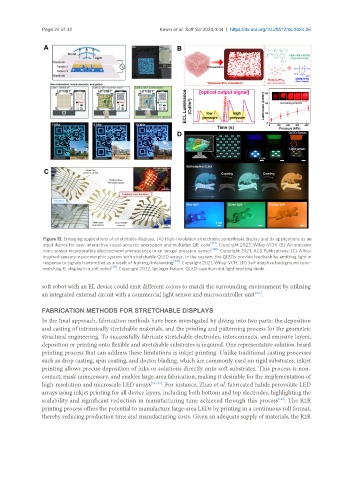
                Figure 13. Emerging applications of stretchable displays. (A) High-resolution stretchable synesthesia display and its applications as an
                input device for user-interactive visual-acoustic encryption and multiplex QR  code [144] . Copyright 2023, Wiley-VCH; (B) An emissive
                ionic sensor incorporating electrochemiluminescence in an ion-gel pressure  sensor [146] . Copyright 2021, ACS Publications; (C) A bio-
                inspired sensory-neuromorphic system with stretchable QLED arrays. In the system, the QLEDs provide feedback by emitting light in
                response to signals transmitted as a result of training/inferencing [150] . Copyright 2021, Wiley-VCH; (D) Self-adaptive background color-
                matching EL display in a soft robot [151] . Copyright 2022, Springer Nature. QLED: quantum dot light-emitting diode.


               soft robot with an EL device could emit different colors to match the surrounding environment by utilizing
               an integrated external circuit with a commercial light sensor and microcontroller unit .
                                                                                       [151]

               FABRICATION METHODS FOR STRETCHABLE DISPLAYS
               In the final approach, fabrication methods have been investigated by diving into two parts: the deposition
               and casting of intrinsically stretchable materials, and the printing and patterning process for the geometric
               structural engineering. To successfully fabricate stretchable electrodes, interconnects, and emissive layers,
               deposition or printing onto flexible and stretchable substrates is required. One representative solution-based
               printing process that can address these limitations is inkjet printing. Unlike traditional casting processes
               such as drop casting, spin coating, and doctor blading, which are commonly used on rigid substrates, inkjet
               printing allows precise deposition of inks or solutions directly onto soft substrates. This process is non-
               contact, mask unnecessary, and enables large-area fabrication, making it desirable for the implementation of
               high-resolution and microscale LED arrays [39,152] . For instance, Zhao et al. fabricated halide perovskite LED
               arrays using inkjet printing for all device layers, including both bottom and top electrodes, highlighting the
                                                                                               [152]
               scalability and significant reduction in manufacturing time achieved through this process . The R2R
               printing process offers the potential to manufacture large-area LEDs by printing in a continuous roll format,
               thereby reducing production time and manufacturing costs. Given an adequate supply of materials, the R2R

