


Page 124 - Read Online
P. 124
Keum et al. Soft Sci 2024;4:34  https://dx.doi.org/10.20517/ss.2024.26          Page 17 of 32


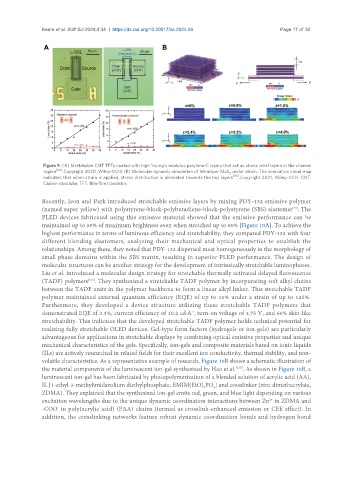
                Figure 9. (A) Stretchable CNT TFTs coated with high Young’s modulus parylene-C layers that act as stress relief layers in the channel
                    [84]
                region  . Copyright 2020, Wiley-VCH; (B) Molecular dynamic simulation of tetralayer MoS  under strain. The simulation cloud map
                                                                              2
                                                                                [85]
                indicates that when strain is applied, stress distribution is alleviated towards the top  layers  . Copyright 2021, Wiley-VCH. CNT:
                Carbon nanotube; TFT: thin-film transistor.
               Recently, Jeon and Park introduced stretchable emissive layers by mixing PDY-132 emissive polymer
               (named super yellow) with polystyrene-block-polybutadiene-block-polystyrene (SBS) elastomer . The
                                                                                                    [99]
               PLED devices fabricated using this emissive material showed that the emissive performance can be
               maintained up to 50% of maximum brightness even when stretched up to 60% [Figure 10A]. To achieve the
               highest performance in terms of luminous efficiency and stretchability, they compared PDY-132 with four
               different blending elastomers, analyzing their mechanical and optical properties to establish the
               relationships. Among these, they noted that PDY-132 dispersed most homogeneously in the morphology of
               small phase domains within the SBS matrix, resulting in superior PLED performance. The design of
               molecular structures can be another strategy for the development of intrinsically stretchable luminophores.
               Liu et al. introduced a molecular design strategy for stretchable thermally activated delayed fluorescence
                               [101]
               (TADF) polymers . They synthesized a stretchable TADF polymer by incorporating soft alkyl chains
               between the TADF units in the polymer backbone to form a linear alkyl linker. This stretchable TADF
               polymer maintained external quantum efficiency (EQE) of up to 10% under a strain of up to 125%.
               Furthermore, they developed a device structure utilizing these stretchable TADF polymers that
               demonstrated EQE of 3.3%, current efficiency of 10.2 cd·A , turn-on voltage of 4.75 V, and 60% skin-like
                                                                  -1
               stretchability. This indicates that the developed stretchable TADF polymer holds technical potential for
               realizing fully stretchable OLED devices. Gel-type form factors (hydrogels or ion-gels) are particularly
               advantageous for applications in stretchable displays by combining optical emissive properties and unique
               mechanical characteristics of the gels. Specifically, ion-gels and composite materials based on ionic liquids
               (ILs) are actively researched in related fields for their excellent ion conductivity, thermal stability, and non-
               volatile characteristics. As a representative example of research, Figure 10B shows a schematic illustration of
               the material components of the luminescent ion-gel synthesized by Hao et al. . As shown in Figure 10B, a
                                                                                [123]
               luminescent ion-gel has been fabricated by photopolymerization of a blended solution of acrylic acid (AA),
               IL [1-ethyl-3-methylimidazolium diethylphosphate, EMIM(EtO) PO ] and crosslinker (zinc dimethacrylate,
                                                                         2
                                                                      2
               ZDMA). They explained that the synthesized ion-gel emits red, green, and blue light depending on various
               excitation wavelengths due to the unique dynamic coordination interactions between Zn  in ZDMA and
                                                                                            2+
               -COO  in poly(acrylic acid) (PAA) chains (termed as crosslink-enhanced emission or CEE effect). In
                    -
               addition, the crosslinking networks feature robust dynamic coordination bonds and hydrogen bond

