


Page 119 - Read Online
P. 119
Page 12 of 32                           Keum et al. Soft Sci 2024;4:34  https://dx.doi.org/10.20517/ss.2024.26

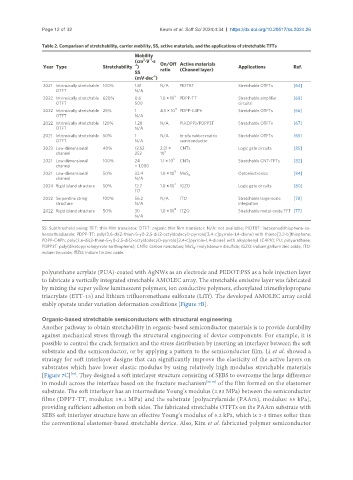
               Table 2. Comparison of stretchability, carrier mobility, SS, active materials, and the applications of stretchable TFTs
                                              Mobility
                                                 2
                                                   -1
                                              (cm ·V ·s  On/Off  Active materials
                                              -1
                Year Type           Stretchability )   ratio  (Channel layer)    Applications       Ref.
                                              SS
                                                     -1
                                              (mV·dec )
                2021 Intrinsically stretchable  100%  1.81   N/A  PIDTBT         Stretchable OTFTs  [64]
                    OTFT                      N/A
                2022 Intrinsically stretchable  620%  0.6   1.0 × 10 5  PDPP-TT  Stretchable amplifier   [68]
                    OTFT                      500                                circuits
                2022 Intrinsically stretchable  25%  1   4.5 × 10 4  PDPP-C4Ph   Stretchable OTFTs  [66]
                    OTFT                      N/A
                2022 Intrinsically stretchable  120%  1.28   N/A  PU(DPP)/PDPP3T  Stretchable OTFTs  [67]
                    OTFT                      N/A
                2021 Intrinsically stretchable  50%  1   N/A  In-situ rubber matrix   Stretchable OTFTs  [65]
                    OTFT                      N/A             semiconductor
                2023 Low-dimensional   40%    12.52    2.31 ×   CNTs             Logic gate circuits  [85]
                    channel                   252      10 5
                                                           5
                2021 Low-dimensional   100%   24       1.1 × 10  CNTs            Stretchable CNT-TFTs  [82]
                    channel                   > 1,000
                                                            8
                2021 Low-dimensional   50%    32.4     1.0 × 10  MoS             Optoelectronics    [84]
                                                                 2
                    channel                   N/A
                                                            7
                2024 Rigid island structure  50%  12.7   1.0 × 10  IGZO          Logic gate circuits  [80]
                                              117
                2022 Serpentine string   100%  56.2    N/A    ITO                Stretchable large-scale   [78]
                    structure                 N/A                                integration
                                                            8
                2022 Rigid island structure  50%  30   1.0 × 10  ITZO            Stretchable metal-oxide TFT [77]
                                              N/A
               SS: Subthreshold swing; TFT: thin-film transistor; OTFT: organic thin film transistor; N/A: not available; PIDTBT: indacenodithiophene-co-
               benzothiadiazole; PDPP-TT: poly(3,6-di(2-thien-5-yl)-2,5-di(2-octyldodecyl)-pyrrolo[3,4-c]pyrrole-1,4-dione) with thieno[3,2-b]thiophene;
               PDPP-C4Ph: poly(3,6-di(2-thien-5-yl)-2,5-di(2-octyldodecyl)-pyrrolo[3,4-c]pyrrole-1,4-dione) with alkylphenyl (C4Ph); PU: polyurethane;
               PDPP3T: poly(diketopyrrolopyrrole-terthiophene); CNTs: carbon nanotubes; MoS : molybdenum disulfide; IGZO: indium gallium zinc oxide; ITO:
                                                                  2
               indium tin oxide; ITZO: indium tin zinc oxide.
               polyurethane acrylate (PUA)-coated with AgNWs as an electrode and PEDOT:PSS as a hole injection layer
               to fabricate a vertically integrated stretchable AMOLEC array. The stretchable emissive layer was fabricated
               by mixing the super yellow luminescent polymers, ion conductive polymers, ethoxylated trimethylopropane
               triacrylate (ETT-15) and lithium trifluoromethane sulfonate (LiTf). The developed AMOLEC array could
               stably operate under variation deformation conditions [Figure 7B].


               Organic-based stretchable semiconductors with structural engineering
               Another pathway to obtain stretchability in organic-based semiconductor materials is to provide durability
               against mechanical stress through the structural engineering of device components. For example, it is
               possible to control the crack formation and the stress distribution by inserting an interlayer between the soft
               substrate and the semiconductor, or by applying a pattern to the semiconductor film. Li et al. showed a
               strategy for soft interlayer designs that can significantly improve the elasticity of the active layers on
               substrates which have lower elastic modulus by using relatively high modulus stretchable materials
               [Figure 7C] . They designed a soft interlayer structure consisting of SEBS to overcome the large difference
                         [87]
               in moduli across the interface based on the fracture mechanism [88-90]  of the film formed on the elastomer
               substrate. The soft interlayer has an intermediate Young’s modulus (2.83 MPa) between the semiconductor
               films (DPPT-TT, modulus: 19.4 MPa) and the substrate [polyacrylamide (PAAm), modulus: 55 kPa],
               providing sufficient adhesion on both sides. The fabricated stretchable OTFTs on the PAAm substrate with
               SEBS soft interlayer structure have an effective Young’s modulus of 5.2 kPa, which is 2-3 times softer than
               the conventional elastomer-based stretchable device. Also, Kim et al. fabricated polymer semiconductor

