


Page 118 - Read Online
P. 118
Keum et al. Soft Sci 2024;4:34  https://dx.doi.org/10.20517/ss.2024.26          Page 11 of 32


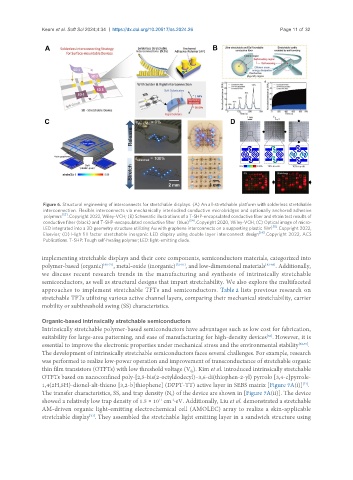
                Figure 6. Structural engineering of interconnects for stretchable displays. (A) An all-stretchable platform with solderless stretchable
                interconnection. Flexible interconnects via mechanically interlocked conductive microbridges and optionally anchored adhesive
                polymers [53] . Copyright 2022, Wiley-VCH; (B) Schematic illustrations of a T-SHP-encapsulated conductive fiber and strain test results of
                conductive fiber (black) and T-SHP-encapsulated conductive fiber (blue) [54] . Copyright 2020, Wiley-VCH; (C) Optical image of micro-
                LED integrated into a 3D geometry structure utilizing Au with graphene interconnects on a supporting plastic  film [55] . Copyright 2022,
                Elsevier; (D) High fill factor stretchable inorganic LED display using double layer interconnect  design [56] . Copyright 2022, ACS
                Publications. T-SHP: Tough self-healing polymer; LED: light-emitting diode.


               implementing stretchable displays and their core components, semiconductors materials, categorized into
               polymer-based (organic) [60-71] , metal-oxide (inorganic) [72-81] , and low-dimensional materials [82-86] . Additionally,
               we discuss recent research trends in the manufacturing and synthesis of intrinsically stretchable
               semiconductors, as well as structural designs that impart stretchability. We also explore the multifaceted
               approaches to implement stretchable TFTs and semiconductors. Table 2 lists previous research on
               stretchable TFTs utilizing various active channel layers, comparing their mechanical stretchability, carrier
               mobility or subthreshold swing (SS) characteristics.

               Organic-based intrinsically stretchable semiconductors
               Intrinsically stretchable polymer-based semiconductors have advantages such as low cost for fabrication,
                                                                                           [62]
               suitability for large-area patterning, and ease of manufacturing for high-density devices . However, it is
               essential to improve the electronic properties under mechanical stress and the environmental stability [62,70] .
               The development of intrinsically stretchable semiconductors faces several challenges. For example, research
               was performed to realize low-power operation and improvement of transconductance of stretchable organic
               thin film transistors (OTFTs) with low threshold voltage (V ). Kim et al. introduced intrinsically stretchable
                                                                 th
               OTFTs based on nanoconfined poly-[2,5-bis(2-octyldodecyl)−3,6-di(thiophen-2-yl) pyrrolo [3,4-c]pyrrole-
                                                                                                       [71]
               1,4(2H,5H)-dionel-alt-thieno [3,2-b]thiophene] (DPPT-TT) active layer in SEBS matrix [Figure 7A(i)] .
               The transfer characteristics, SS, and trap density (N) of the device are shown in [Figure 7A(ii)]. The device
                                                           t
               showed a relatively low trap density of 1.5 × 10  cm ·eV. Additionally, Liu et al. demonstrated a stretchable
                                                           -2
                                                       11
               AM-driven organic light-emitting electrochemical cell (AMOLEC) array to realize a skin-applicable
               stretchable display . They assembled the stretchable light emitting layer in a sandwich structure using
                               [61]

