


Page 113 - Read Online
P. 113
Page 6 of 32                            Keum et al. Soft Sci 2024;4:34  https://dx.doi.org/10.20517/ss.2024.26


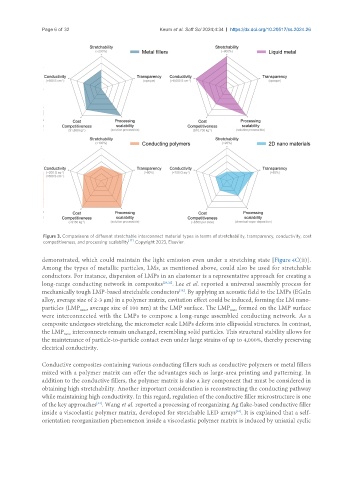
                Figure 3. Comparisons of different stretchable interconnect material types in terms of stretchability, transparency, conductivity, cost
                competitiveness, and processing scalability [17] . Copyright 2023, Elsevier.


               demonstrated, which could maintain the light emission even under a stretching state [Figure 4C(ii)].
               Among the types of metallic particles, LMs, as mentioned above, could also be used for stretchable
               conductors. For instance, dispersion of LMPs in an elastomer is a representative approach for creating a
               long-range conducting network in composites [28,32] . Lee et al. reported a universal assembly process for
               mechanically tough LMP-based stretchable conductors . By applying an acoustic field to the LMPs (EGaIn
                                                             [28]
               alloy, average size of 2-3 μm) in a polymer matrix, cavitation effect could be induced, forming the LM nano-
               particles (LMP , average size of 100 nm) at the LMP surface. The LMP  formed on the LMP surface
                                                                               nano
                            nano
               were interconnected with the LMPs to compose a long-range assembled conducting network. As a
               composite undergoes stretching, the micrometer scale LMPs deform into ellipsoidal structures. In contrast,
               the LMP  interconnects remain unchanged, resembling solid particles. This structural stability allows for
                       nano
               the maintenance of particle-to-particle contact even under large strains of up to 4,000%, thereby preserving
               electrical conductivity.


               Conductive composites containing various conducting fillers such as conductive polymers or metal fillers
               mixed with a polymer matrix can offer the advantages such as large-area printing and patterning. In
               addition to the conductive fillers, the polymer matrix is also a key component that must be considered in
               obtaining high stretchability. Another important consideration is reconstructing the conducting pathway
               while maintaining high conductivity. In this regard, regulation of the conductive filler microstructure is one
               of the key approaches . Wang et al. reported a processing of reorganizing Ag flake-based conductive filler
                                  [33]
                                                                                [33]
               inside a viscoelastic polymer matrix, developed for stretchable LED arrays . It is explained that a self-
               orientation reorganization phenomenon inside a viscoelastic polymer matrix is induced by uniaxial cyclic

