


Page 112 - Read Online
P. 112
Keum et al. Soft Sci 2024;4:34  https://dx.doi.org/10.20517/ss.2024.26           Page 5 of 32

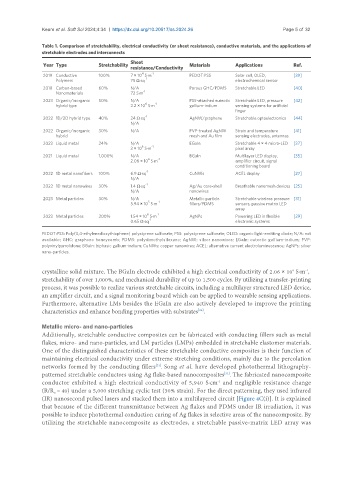
               Table 1. Comparison of stretchability, electrical conductivity (or sheet resistance), conductive materials, and the applications of
               stretchable electrodes and interconnects
                                             Sheet
                Year Type         Stretchability                 Materials      Applications        Ref.
                                             resistance/Conductivity
                                                 4  -1
                2019 Conductive   100%       7 × 10  S·m         PEDOT:PSS      Solar cell, OLED,   [39]
                    Polymers                 75 Ω·sq -1                         electrochemical sensor
                2018 Carbon-based   60%      N/A                 Porous GHC/PDMS  Stretchable LED   [40]
                                                 -1
                    Nanomaterials            72 S·m
                2023 Organic/inorganic   50%  N/A                PSS-attached eutectic  Stretchable LED, pressure   [42]
                                                  6  -1
                    hybrid type              2.2 × 10  S·m       gallium-indium  sensing systems for artificial
                                                                                finger
                                                  -1
                2022 1D/2D hybrid type  40%  24 Ω·sq             AgNW/graphene  Stretchable optoelectronics  [44]
                                             N/A
                2022 Organic/inorganic   30%  N/A                PVP-treated AgNW   Strain and temperature   [41]
                    hybrid                                       mesh and Au film  sensing electrodes, antennas
                2023 Liquid metal  24%       N/A                 EGaIn          Stretchable 4 × 4 micro-LED   [37]
                                                 6  -1
                                             3 × 10  S·m                        pixel array
                2021 Liquid metal  1,000%    N/A                 BGaIn          Multilayer LED display,   [35]
                                                   6  -1
                                             2.06 × 10  S·m                     amplifier circuit, signal
                                                                                conditioning board
                                                  -1
                2022 1D metal nanofibers  100%  6.9 Ω·sq         CuNWs          ACEL display        [27]
                                             N/A
                                                  -1
                2022 1D metal nanowires  30%  1.4 Ω·sq           Ag/Au core-shell   Breathable nanomesh devices [25]
                                             N/A                 nanowires
                2023 Metal particles  30%    N/A                 Metallic particle   Stretchable wireless pressure  [31]
                                                   5  -1
                                             5.94 × 10  S·m      fillers/PDMS   sensors, passive matrix LED
                                                                                array
                                                   6  -1
                2023 Metal particles  200%   1.54 × 10  S·m      AgNPs          Powering LED in flexible   [29]
                                                   -1
                                             0.65 Ω·sq                          electronic systems
               PEDOT:PSS: Poly(3,4-ethylenedioxythiophene) polystyrene sulfonate; PSS: polystyrene sulfonate; OLED: organic light-emitting diode; N/A: not
               available;  GHC:  graphene  honeycomb;  PDMS:  polydimethylsiloxane;  AgNW:  silver  nanowires;  EGaIn:  eutectic  gallium-indium;  PVP:
               polyvinylpyrrolidone; BGaIn: biphasic gallium-indium; CuNWs: copper nanowires; ACEL: alternative current electroluminescence; AgNPs: silver
               nano-particles.
                                                                                                        -1
                                                                                                    6
               crystalline solid mixture. The BGaIn electrode exhibited a high electrical conductivity of 2.06 × 10  S·m ,
               stretchability of over 1,000%, and mechanical durability of up to 1,500 cycles. By utilizing a transfer-printing
               process, it was possible to realize various stretchable circuits, including a multilayer structured LED device,
               an amplifier circuit, and a signal monitoring board which can be applied to wearable sensing applications.
               Furthermore, alternative LMs besides the EGaIn are also actively developed to improve the printing
                                                                    [36]
               characteristics and enhance bonding properties with substrates .
               Metallic micro- and nano-particles
               Additionally, stretchable conductive composites can be fabricated with conducting fillers such as metal
               flakes, micro- and nano-particles, and LM particles (LMPs) embedded in stretchable elastomer materials.
               One of the distinguished characteristics of these stretchable conductive composites is their function of
               maintaining electrical conductivity under extreme stretching conditions, mainly due to the percolation
                                                     [31]
               networks formed by the conducting fillers . Song et al. have developed photothermal lithography-
                                                                             [31]
               patterned stretchable conductors using Ag flake-based nanocomposites . The fabricated nanocomposite
               conductor exhibited a high electrical conductivity of 5,940 S·cm  and negligible resistance change
                                                                          -1
               (R/R  = 40) under a 5,000 stretching cyclic test (30% strain). For the direct patterning, they used infrared
                   0
               (IR) nanosecond pulsed lasers and stacked them into a multilayered circuit [Figure 4C(i)]. It is explained
               that because of the different transmittance between Ag flakes and PDMS under IR irradiation, it was
               possible to induce photothermal conduction curing of Ag flakes in selective areas of the nanocomposite. By
               utilizing the stretchable nanocomposite as electrodes, a stretchable passive-matrix LED array was

