


Page 117 - Read Online
P. 117
Page 10 of 32                           Keum et al. Soft Sci 2024;4:34  https://dx.doi.org/10.20517/ss.2024.26

                                  [53]
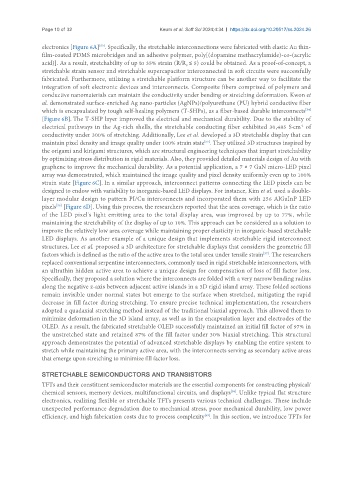
               electronics [Figure 6A] . Specifically, the stretchable interconnections were fabricated with elastic Au thin-
               film-coated PDMS microbridges and an adhesive polymer, poly[(dopamine methacrylamide)-co-(acrylic
               acid)]. As a result, stretchability of up to 35% strain (R/R  ≤ 5) could be obtained. As a proof-of-concept, a
                                                                0
               stretchable strain sensor and stretchable supercapacitor interconnected in soft circuits were successfully
               fabricated. Furthermore, utilizing a stretchable platform structure can be another way to facilitate the
               integration of soft electronic devices and interconnects. Composite fibers comprised of polymers and
               conductive nanomaterials can maintain the conductivity under bending or stretching deformation. Kwon et
               al. demonstrated surface-enriched Ag nano-particles (AgNPs)/polyurethane (PU) hybrid conductive fiber
               which is encapsulated by tough self-healing polymers (T-SHPs), as a fiber-based durable interconnects
                                                                                                        [54]
               [Figure 6B]. The T-SHP layer improved the electrical and mechanical durability. Due to the stability of
               electrical pathways in the Ag-rich shells, the stretchable conducting fiber exhibited 30,485 S·cm  of
                                                                                                      -1
               conductivity under 300% of stretching. Additionally, Lee et al. developed a 3D stretchable display that can
               maintain pixel density and image quality under 100% strain state . They utilized 3D structures inspired by
                                                                      [55]
               the origami and kirigami structures, which are structural engineering techniques that impart stretchability
               by optimizing stress distribution in rigid materials. Also, they provided detailed materials design of Au with
               graphene to improve the mechanical durability. As a potential application, a 7 × 7 GaN micro-LED pixel
               array was demonstrated, which maintained the image quality and pixel density uniformly even up to 100%
               strain state [Figure 6C]. In a similar approach, interconnect patterns connecting the LED pixels can be
               designed to endow with variability to inorganic-based LED displays. For instance, Kim et al. used a double-
               layer modular design to pattern PI/Cu interconnects and incorporated them with 256 AlGaInP LED
               pixels  [Figure 6D]. Using this process, the researchers reported that the area coverage, which is the ratio
                    [56]
               of the LED pixel's light emitting area to the total display area, was improved by up to 77%, while
               maintaining the stretchability of the display of up to 10%. This approach can be considered as a solution to
               improve the relatively low area coverage while maintaining proper elasticity in inorganic-based stretchable
               LED displays. As another example of a unique design that implements stretchable rigid interconnect
               structures, Lee et al. proposed a 3D architecture for stretchable displays that considers the geometric fill
                                                                                          [57]
               factors which is defined as the ratio of the active area to the total area under tensile strain . The researchers
               replaced conventional serpentine interconnectors, commonly used in rigid stretchable interconnectors, with
               an ultrathin hidden active area to achieve a unique design for compensation of loss of fill factor loss.
               Specifically, they proposed a solution where the interconnects are folded with a very narrow bending radius
               along the negative z-axis between adjacent active islands in a 3D rigid island array. These folded sections
               remain invisible under normal states but emerge to the surface when stretched, mitigating the rapid
               decrease in fill factor during stretching. To ensure precise technical implementation, the researchers
               adopted a quadaxial stretching method instead of the traditional biaxial approach. This allowed them to
               minimize deformation in the 3D island array, as well as in the encapsulation layer and electrodes of the
               OLED. As a result, the fabricated stretchable OLED successfully maintained an initial fill factor of 97% in
               the unstretched state and retained 87% of the fill factor under 30% biaxial stretching. This structural
               approach demonstrates the potential of advanced stretchable displays by enabling the entire system to
               stretch while maintaining the primary active area, with the interconnects serving as secondary active areas
               that emerge upon stretching to minimize fill factor loss.

               STRETCHABLE SEMICONDUCTORS AND TRANSISTORS
               TFTs and their constituent semiconductor materials are the essential components for constructing physical/
               chemical sensors, memory devices, multifunctional circuits, and displays . Unlike typical flat structure
                                                                               [58]
               electronics, realizing flexible or stretchable TFTs presents various technical challenges. These include
               unexpected performance degradation due to mechanical stress, poor mechanical durability, low power
                                                                      [59]
               efficiency, and high fabrication costs due to process complexity . In this section, we introduce TFTs for

