


Page 84 - Read Online
P. 84
Page 10 of 27                            Kim et al. Soft Sci 2024;4:24  https://dx.doi.org/10.20517/ss.2024.09


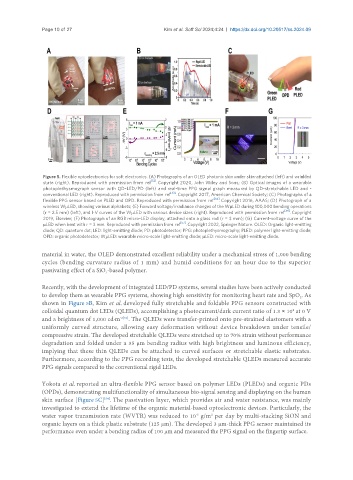
                Figure 5. Flexible optoelectronics for soft electronics. (A) Photographs of an OLED photonic skin under skin-attached (left) and wrinkled
                state (right). Reproduced with permission from  ref [52] . Copyright 2020, John Wiley and Sons; (B) Optical images of a wearable
                photoplethysmograph sensor with QD-LED/PD (left) and real-time PPG signal graph measured by QD-stretchable LED and -
                conventional LED (right). Reproduced with permission from ref [53] . Copyright 2017, American Chemical Society; (C) Photographs of a
                flexible PPG sensor based on PLED and OPD. Reproduced with permission from  ref [54] . Copyright 2016, AAAS; (D) Photograph of a
                wireless WμLED, showing various alphabets; (E) Forward voltage/irradiance changes of the WμLED during 100,000 bending operations
                (r = 2.5 mm) (left), and I-V curves of the WμLED with various device sizes (right). Reproduced with permission from ref [56] . Copyright
                2019, Elsevier; (F) Photograph of an RGB micro-LED display, attached onto a glass rod (r = 3 mm); (G) Current-voltage curve of the
                                                              [57]
                µLED when bent with r = 3 mm. Reproduced with permission from ref  . Copyright 2022, Springer Nature. OLED: Organic light-emitting
                diode; QD: quantum dot; LED: light-emitting diode; PD: photodetector; PPG: photoplethysmography; PLED: polymer light-emitting diode;
                OPD: organic photodetector; WμLED: wearable micro-scale light-emitting diode; µLED: micro-scale light-emitting diode.

               material in water, the OLED demonstrated excellent reliability under a mechanical stress of 1,000 bending
               cycles (bending curvature radius of 1 mm) and humid conditions for an hour due to the superior
               passivating effect of a SiO -based polymer.
                                     2

               Recently, with the development of integrated LED/PD systems, several studies have been actively conducted
               to develop them as wearable PPG systems, showing high sensitivity for monitoring heart rate and SpO . As
                                                                                                      2
               shown in Figure 5B, Kim et al. developed fully stretchable and foldable PPG sensors constructed with
               colloidal quantum dot LEDs (QLEDs), accomplishing a photocurrent/dark current ratio of 1.3 × 10  at 0 V
                                                                                                    4
               and a brightness of 1,000 cd·m -2[53] . The QLEDs were transfer-printed onto pre-strained elastomers with a
               uniformly curved structure, allowing easy deformation without device breakdown under tensile/
               compressive strain. The developed stretchable QLEDs were stretched up to 70% strain without performance
               degradation and folded under a 35 μm bending radius with high brightness and luminous efficiency,
               implying that these thin QLEDs can be attached to curved surfaces or stretchable elastic substrates.
               Furthermore, according to the PPG recording tests, the developed stretchable QLEDs measured accurate
               PPG signals compared to the conventional rigid LEDs.


               Yokota et al. reported an ultra-flexible PPG sensor based on polymer LEDs (PLEDs) and organic PDs
               (OPDs), demonstrating multifunctionality of simultaneous bio-signal sensing and displaying on the human
                                    [54]
               skin surface [Figure 5C] . The passivation layer, which provides air and water resistance, was mainly
               investigated to extend the lifetime of the organic material-based optoelectronic devices. Particularly, the
               water vapor transmission rate (WVTR) was reduced to 10  g/m  per day by multi-stacking SiON and
                                                                        2
                                                                   -5
               organic layers on a thick plastic substrate (125 μm). The developed 3 µm-thick PPG sensor maintained its
               performance even under a bending radius of 100 µm and measured the PPG signal on the fingertip surface.

