


Page 86 - Read Online
P. 86
Page 12 of 27                            Kim et al. Soft Sci 2024;4:24  https://dx.doi.org/10.20517/ss.2024.09


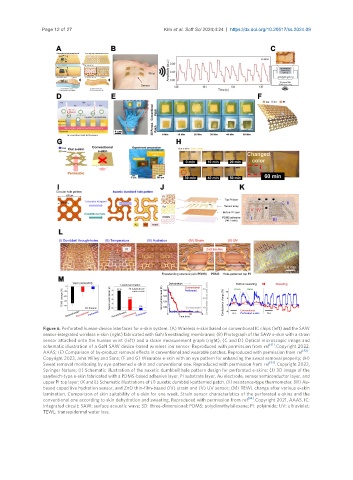
                Figure 6. Perforated human-device interfaces for e-skin system. (A) Wireless e-skin based on conventional IC chips (left) and the SAW
                sensor-integrated wireless e-skin (right) fabricated with GaN freestanding membranes; (B) Photograph of the SAW e-skin with a strain
                sensor attached onto the human wrist (left) and a strain measurement graph (right); (C and D) Optical microscopic image and
                                                                                            [61]
                schematic illustration of a GaN SAW device-based wireless ion sensor. Reproduced with permission from  ref  . Copyright 2022,
                AAAS; (E) Comparison of by-product removal effects in conventional and wearable patches. Reproduced with permission from ref [62] .
                Copyright 2023, John Wiley and Sons; (F and G) Wearable e-skin with an eye pattern for enhancing the sweat removal property; (H)
                Sweat removal monitoring by eye-patterned e-skin and conventional one. Reproduced with permission from  ref [63] . Copyright 2023,
                Springer Nature; (I) Schematic illustration of the auxetic dumbbell hole pattern design for perforated e-skins; (J) 3D image of the
                sandwich-type e-skin fabricated with a PDMS-based adhesive layer, PI substrate layer, Au electrode, sensor semiconductor layer, and
                upper PI top layer; (K and L) Schematic illustrations of (I) auxetic dumbbell-patterned patch, (II) resistance-type thermometer, (III) Au-
                based capacitive hydration sensor, and ZnO thin-film-based (IV) strain and (V) UV sensor; (M) TEWL change after various e-skin
                lamination. Comparison of skin suitability of e-skin for one week. Strain sensor characteristics of the perforated e-skins and the
                conventional one according to skin dehydration and sweating. Reproduced with permission from  ref [64] . Copyright 2021, AAAS. IC:
                Integrated circuit; SAW: surface acoustic wave; 3D: three-dimensional; PDMS: polydimethylsiloxane; PI: polyimide; UV: ultraviolet;
                TEWL: transepidermal water loss.

