


Page 87 - Read Online
P. 87
Kim et al. Soft Sci 2024;4:24  https://dx.doi.org/10.20517/ss.2024.09           Page 13 of 27

               Recently, wearable substrates with perforated patterns have been actively investigated to prevent dermal
               issues by mechanically removing skin by-products over a long-term period. Kim et al. demonstrated a
               wearable and biocompatible 3D porous patch combined with InGaN/GaN-based micro-PDs (μPD) as an
                                               [62]
               ultraviolet (UV) monitoring sensor . The porous PDMS patch was fabricated by compressing sugar
               microparticles (diameter of 420~480 μm), filling them with PDMS, and removing the sugar-based mold. To
               verify the by-product removal property of the developed porous patch, sweat permeability tests between the
               3D porous skin and the conventional one were carried out on the perspiring hand, showing rapid color
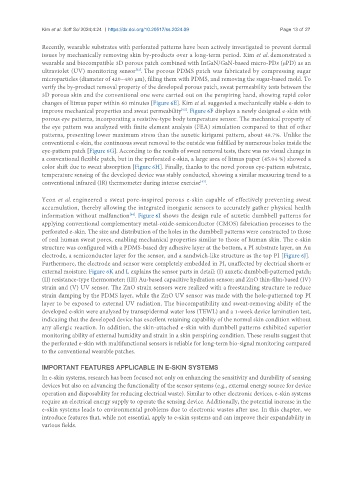
               changes of litmus paper within 60 minutes [Figure 6E]. Kim et al. suggested a mechanically stable e-skin to
               improve mechanical properties and sweat permeability . Figure 6F displays a newly designed e-skin with
                                                              [62]
               porous eye patterns, incorporating a resistive-type body temperature sensor. The mechanical property of
               the eye pattern was analyzed with finite element analysis (FEA) simulation compared to that of other
               patterns, presenting lower maximum stress than the auxetic kirigami pattern, about 48.7%. Unlike the
               conventional e-skin, the continuous sweat removal to the outside was fulfilled by numerous holes inside the
               eye-pattern patch [Figure 6G]. According to the results of sweat removal tests, there was no visual change in
               a conventional flexible patch, but in the perforated e-skin, a large area of litmus paper (45.04 %) showed a
               color shift due to sweat absorption [Figure 6H]. Finally, thanks to the novel porous eye-pattern substrate,
               temperature sensing of the developed device was stably conducted, showing a similar measuring trend to a
                                                                     [63]
               conventional infrared (IR) thermometer during intense exercise .
               Yeon et al. engineered a sweat pore-inspired porous e-skin capable of effectively preventing sweat
               accumulation, thereby allowing the integrated inorganic sensors to accurately gather physical health
               information without malfunction . Figure 6I shows the design rule of auxetic dumbbell patterns for
                                             [64]
               applying conventional complementary metal-oxide-semiconductor (CMOS) fabrication processes to the
               perforated e-skin. The size and distribution of the holes in the dumbbell patterns were constructed to those
               of real human sweat pores, enabling mechanical properties similar to those of human skin. The e-skin
               structure was configured with a PDMS-based dry adhesive layer at the bottom, a PI substrate layer, an Au
               electrode, a semiconductor layer for the sensor, and a sandwich-like structure as the top PI [Figure 6J].
               Furthermore, the electrode and sensor were completely embedded in PI, unaffected by electrical shorts or
               external moisture. Figure 6K and L explains the sensor parts in detail: (I) auxetic dumbbell-patterned patch;
               (II) resistance-type thermometer; (III) Au-based capacitive hydration sensor; and ZnO thin-film-based (IV)
               strain and (V) UV sensor. The ZnO strain sensors were realized with a freestanding structure to reduce
               strain damping by the PDMS layer, while the ZnO UV sensor was made with the hole-patterned top PI
               layer to be exposed to external UV radiation. The biocompatibility and sweat-removing ability of the
               developed e-skin were analyzed by transepidermal water loss (TEWL) and a 1-week device lamination test,
               indicating that the developed device has excellent retaining capability of the normal skin condition without
               any allergic reaction. In addition, the skin-attached e-skin with dumbbell patterns exhibited superior
               monitoring ability of external humidity and strain in a skin perspiring condition. These results suggest that
               the perforated e-skin with multifunctional sensors is reliable for long-term bio-signal monitoring compared
               to the conventional wearable patches.


               IMPORTANT FEATURES APPLICABLE IN E-SKIN SYSTEMS
               In e-skin systems, research has been focused not only on enhancing the sensitivity and durability of sensing
               devices but also on advancing the functionality of the sensor systems (e.g., external energy source for device
               operation and disposability for reducing electrical waste). Similar to other electronic devices, e-skin systems
               require an electrical energy supply to operate the sensing device. Additionally, the potential increase in the
               e-skin systems leads to environmental problems due to electronic wastes after use. In this chapter, we
               introduce features that, while not essential, apply to e-skin systems and can improve their expandability in
               various fields.

