


Page 89 - Read Online
P. 89
Kim et al. Soft Sci 2024;4:24  https://dx.doi.org/10.20517/ss.2024.09           Page 15 of 27


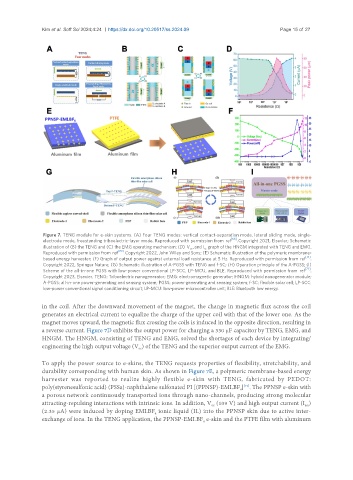
                Figure 7. TENG module for e-skin systems. (A) Four TENG modes: vertical contact-separation mode, lateral sliding mode, single-
               electrode mode, freestanding triboelectric-layer mode. Reproduced with permission from  ref [68] . Copyright 2021, Elsevier; Schematic
                illustration of (B) the TENG and (C) the EMG operating mechanism; (D) V , and I  graph of the HNGM integrated with TENG and EMG.
                                                                 oc
                                                                      sc
                Reproduced with permission from ref [70] . Copyright 2022, John Wiley and Sons; (E) Schematic illustration of the polymeric membrane-
                based energy harvester; (F) Graph of output power against external load resistance at 5 Hz. Reproduced with permission from  ref [71] .
                Copyright 2022, Springer Nature; (G) Schematic illustration of A-PGSS with TENG and f-SC; (H) Operation principle of the A-PGSS; (I)
                Scheme of the all-in-one PGSS with low-power conventional LP-SCC, LP-MCU, and BLE. Reproduced with permission from  ref [72] .
                Copyright 2023, Elsevier. TENG: Triboelectric nanogenerator; EMG: electromagnetic generator; HNGM: hybrid nanogenerator module;
                A-PGSS: all-in-one power-generating and sensing system; PGSS: power-generating and sensing system; f-SC: flexible solar cell; LP-SCC:
                low-power conventional signal conditioning circuit; LP-MCU: low-power microcontroller unit; BLE: Bluetooth low energy.

               in the coil. After the downward movement of the magnet, the change in magnetic flux across the coil
               generates an electrical current to equalize the charge of the upper coil with that of the lower one. As the
               magnet moves upward, the magnetic flux crossing the coils is induced in the opposite direction, resulting in
               a reverse current. Figure 7D exhibits the output power for charging a 330 µF capacitor by TENG, EMG, and
               HNGM. The HNGM, consisting of TENG and EMG, solved the shortages of each device by integrating/
               engineering the high output voltage (V ) of the TENG and the superior output current of the EMG.
                                                oc

               To apply the power source to e-skins, the TENG requests properties of flexibility, stretchability, and
               durability corresponding with human skin. As shown in Figure 7E, a polymeric membrane-based energy
               harvester  was  reported  to  realize  highly  flexible  e-skin  with  TENG,  fabricated  by  PEDOT:
               poly(styrenesulfonic acid) (PSSa)-naphthalene sulfonated PI [(PPNSP)-EMI.BF ] . The PPNSP e-skin with
                                                                                   [71]
                                                                                  4
               a porous network continuously transported ions through nano-channels, producing strong molecular
               attracting-repulsing interactions with intrinsic ions. In addition, V  (109 V) and high output current (I )
                                                                        oc
                                                                                                        scs
               (2.35 µA) were induced by doping EMI.BF  ionic liquid (IL) into the PPNSP skin due to active inter-
                                                     4
               exchange of ions. In the TENG application, the PPNSP-EMI.BF  e-skin and the PTFE film with aluminum
                                                                     4

