


Page 80 - Read Online
P. 80
Page 6 of 27                             Kim et al. Soft Sci 2024;4:24  https://dx.doi.org/10.20517/ss.2024.09


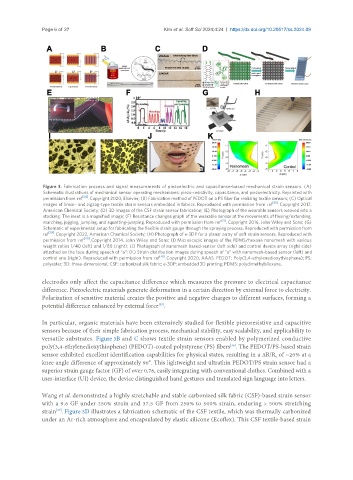
                Figure 3. Fabrication process and signal measurements of piezoelectric and capacitance-based mechanical strain sensors. (A)
                Schematic illustrations of mechanical sensor operating mechanisms: piezo-resistivity, capacitance, and piezoelectricity. Reprinted with
                permission from ref [34] . Copyright 2020, Elsevier; (B) Fabrication method of PEDOT on a PS fiber for realizing textile sensors; (C) Optical
                images of linear- and zigzag-type textile strain sensors embedded in fabrics. Reproduced with permission from ref [36] . Copyright 2017,
                American Chemical Society; (D) 3D images of the CSF strain sensor fabrication; (E) Photograph of the wearable sensors weaved into a
                stocking. The inset is a magnified image; (F) Resistance changes graph of the wearable sensor at the movements of flexing/extending,
                marching, jogging, jumping, and squatting-jumping. Reproduced with permission from ref [37] . Copyright 2016, John Wiley and Sons; (G)
                Schematic of experimental setup for fabricating the flexible strain gauge through the spraying process. Reproduced with permission from
                ref [39] . Copyright 2022, American Chemical Society; (H) Photograph of e-3DP for a planar array of soft strain sensors. Reproduced with
                permission from  ref [40] . Copyright 2014, John Wiley and Sons; (I) Microscopic images of the PDMS/hexane nanomesh with various
                weight ratios 1/40 (left) and 1/80 (right); (J) Photograph of nanomesh based-sensor (left side) and control device array (right side)
                attached on the face during speech of “a”; (K) Strain distribution images during speech of “a” with nanomesh-based sensor (left) and
                control one (right). Reproduced with permission from  ref [41] . Copyright 2020, AAAS. PEDOT: Poly(3,4-ethylenedioxythiophene); PS:
                polyester; 3D: three-dimensional; CSF: carbonized silk fabric; e-3DP: embedded 3D printing; PDMS: polydimethylsiloxane.

               electrodes only affect the capacitance difference which measures the pressure to electrical capacitance
               difference. Piezoelectric materials generate deformation in a certain direction by external force to electricity.
               Polarization of sensitive material creates the positive and negative charges to different surfaces, forming a
               potential difference enhanced by external force .
                                                      [35]
               In particular, organic materials have been extensively studied for flexible piezoresistive and capacitive
               sensors because of their simple fabrication process, mechanical stability, easy scalability, and applicability to
               versatile substrates. Figure 3B and C shows textile strain sensors enabled by polymerized conductive
               poly(3,4-ethylenedioxythiophene) (PEDOT)-coated polystyrene (PS) fibers . The PEDOT/PS-based strain
                                                                               [36]
               sensor exhibited excellent identification capabilities for physical states, resulting in a ΔR/R  of ~20% at a
                                                                                              0
               knee angle difference of approximately 90°. This lightweight and ultrathin PEDOT/PS strain sensor had a
               superior strain gauge factor (GF) of over 0.76, easily integrating with conventional clothes. Combined with a
               user-interface (UI) device, the device distinguished hand gestures and translated sign language into letters.

               Wang et al. demonstrated a highly stretchable and stable carbonized silk fabric (CSF)-based strain sensor
               with a 9.6 GF under 250% strain and 37.5 GF from 250% to 500% strain, enduring > 500% stretching
               strain . Figure 3D illustrates a fabrication schematic of the CSF textile, which was thermally carbonized
                    [37]
               under an Ar-rich atmosphere and encapsulated by elastic silicone (Ecoflex). This CSF textile-based strain

