


Page 22 - Read Online
P. 22
Zhu et al. Soft Sci 2024;4:17  https://dx.doi.org/10.20517/ss.2024.05            Page 9 of 38


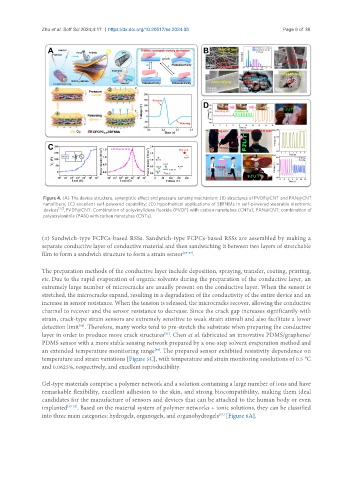
                Figure 4. (A) The device structure, synergistic effect and pressure sensing mechanism; (B) structures of PVDF@CNT and PAN@CNT
                nanofibers; (C) excellent self-powered capability; (D) hypothetical applications of SBFNMs in self-powered wearable electronic
                devices [72] . PVDF@CNT: Combination of polyvinylidene fluoride (PVDF) with carbon nanotubes (CNTs); PAN@CNT: combination of
                polyacrylonitrile (PAN) with carbon nanotubes (CNTs).


               (2) Sandwich-type FCPCs-based RSSs. Sandwich-type FCPCs-based RSSs are assembled by making a
               separate conductive layer of conductive material and then sandwiching it between two layers of stretchable
               film to form a sandwich structure to form a strain sensor [85-87] .

               The preparation methods of the conductive layer include deposition, spraying, transfer, coating, printing,
               etc. Due to the rapid evaporation of organic solvents during the preparation of the conductive layer, an
               extremely large number of microcracks are usually present on the conductive layer. When the sensor is
               stretched, the microcracks expand, resulting in a degradation of the conductivity of the entire device and an
               increase in sensor resistance. When the tension is released, the microcracks recover, allowing the conductive
               channel to recover and the sensor resistance to decrease. Since the crack gap increases significantly with
               strain, crack-type strain sensors are extremely sensitive to weak strain stimuli and also facilitate a lower
               detection limit . Therefore, many works tend to pre-stretch the substrate when preparing the conductive
                            [88]
               layer in order to produce more crack structures . Chen et al. fabricated an innovative PDMS/graphene/
                                                        [81]
               PDMS sensor with a more stable sensing network prepared by a one-step solvent evaporation method and
                                                     [84]
               an extended temperature monitoring range . The prepared sensor exhibited resistivity dependence on
               temperature and strain variations [Figure 5C], with temperature and strain monitoring resolutions of 0.5 °C
               and 0.0625%, respectively, and excellent reproducibility.


               Gel-type materials comprise a polymer network and a solution containing a large number of ions and have
               remarkable flexibility, excellent adhesion to the skin, and strong biocompatibility, making them ideal
               candidates for the manufacture of sensors and devices that can be attached to the human body or even
               implanted [89-92] . Based on the material system of polymer networks + ionic solutions, they can be classified
               into three main categories: hydrogels, organogels, and organohydrogels  [Figure 6A].
                                                                           [93]

