


Page 20 - Read Online
P. 20
Zhu et al. Soft Sci 2024;4:17  https://dx.doi.org/10.20517/ss.2024.05            Page 7 of 38


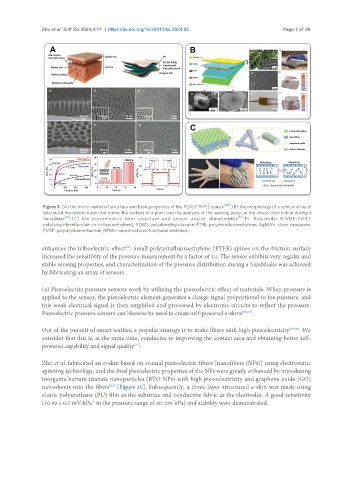
                Figure 3. (A) the micro-vertebral structure and basic properties of the P(VDF-TrFE) sensor [60] ; (B) the morphology of a conical array of
                interlaced microstructures that mimic the surface of a plant and the analysis of the sensing array on the stress distribution during a
                handshake [61] ; (C)  the  piezoelectric  fiber  structure  and  sensor  device  characteristics [62] . PI:  Polyimide;  P(VDF-TrFE):
                poly(vinylidenefluoride-co-trifluoroethylene); PDMS: polydimethylsiloxane; PTFE: polytetrafluoroethylene; AgNWs: silver nanowires;
                PVDF: polyvinylidene fluoride; NFMs: nanostructured functional materials.


               enhances the triboelectric effect . Small polytetrafluoroethylene (PTFE) spines on the friction surface
                                           [61]
               increased the sensitivity of the pressure measurement by a factor of 14. The sensor exhibits very regular and
               stable sensing properties, and characterization of the pressure distribution during a handshake was achieved
               by fabricating an array of sensors.


               (4) Piezoelectric pressure sensors work by utilizing the piezoelectric effect of materials. When pressure is
               applied to the sensor, the piezoelectric element generates a charge signal proportional to the pressure, and
               this weak electrical signal is then amplified and processed by electronic circuits to reflect the pressure.
               Piezoelectric pressure sensors can likewise be used to create self-powered e-skins [35,67] .


               Out of the pursuit of smart textiles, a popular strategy is to make fibers with high piezoelectricity [68-70] . We
               consider that this is, at the same time, conducive to improving the contact area and obtaining better self-
               powered capability and signal quality .
                                              [71]

               Zhu et al. fabricated an e-skin based on coaxial piezoelectric fibers [nanofibers (NFs)] using electrostatic
               spinning technology, and the final piezoelectric properties of the NFs were greatly enhanced by introducing
               inorganic barium titanate nanoparticles (BTO NPs) with high piezoelectricity and graphene oxide (GO)
                                      [62]
               nanosheets into the fibers  [Figure 3C]. Subsequently, a three-layer structured e-skin was made using
               elastic polyurethane (PU) film as the substrate and conductive fabric as the electrodes. A good sensitivity
               (10.89 ± 0.5 mV·kPa  in the pressure range of 80-230 kPa) and stability were demonstrated.
                                -1

