


Page 23 - Read Online
P. 23
Page 10 of 38                            Zhu et al. Soft Sci 2024;4:17  https://dx.doi.org/10.20517/ss.2024.05


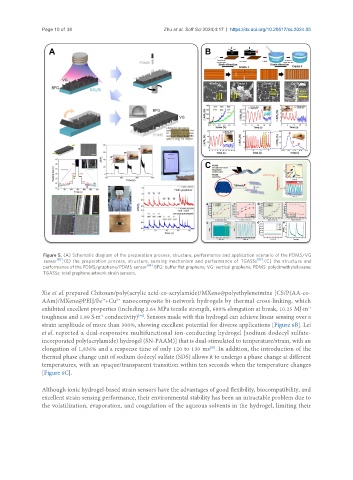
                Figure 5. (A) Schematic diagram of the preparation process, structure, performance and application scenario of the PDMS/VG
                sensor [82] ; (B)  the  preparation  process,  structure,  sensing  mechanism  and  performance  of  TGASSs [83] ; (C)  the  structure  and
                performance of the PDMS/graphene/PDMS sensor [84] . BFG: buffer flat graphene; VG: vertical graphene; PDMS: polydimethylsiloxane;
                TGASSs: total graphene artwork strain sensors.


               Xie et al. prepared Chitosan/poly(acrylic acid-co-acrylamide)/MXene@polyethyleneimine [CS/P(AA-co-
                                   3+
                                        2+
               AAm)/MXene@PEI]/Fe +Cu  nanocomposite bi-network hydrogels by thermal cross-linking, which
               exhibited excellent properties (including 2.64 MPa tensile strength, 689% elongation at break, 10.25 MJ·m
                                                                                                         -3
                                                [94]
               toughness and 1.89 S·m  conductivity) . Sensors made with this hydrogel can achieve linear sensing over a
                                   -1
               strain amplitude of more than 300%, showing excellent potential for diverse applications [Figure 6B]. Lei
               et al. reported a dual-responsive multifunctional ion-conducting hydrogel [sodium dodecyl sulfate-
               incorporated poly(acrylamide) hydrogel (SN-PAAM)] that is dual-stimulated to temperature/strain, with an
                                                                        [95]
               elongation of 1,836% and a response time of only 120 to 130 ms . In addition, the introduction of the
               thermal phase change unit of sodium dodecyl sulfate (SDS) allows it to undergo a phase change at different
               temperatures, with an opaque/transparent transition within ten seconds when the temperature changes
               [Figure 6C].

               Although ionic hydrogel-based strain sensors have the advantages of good flexibility, biocompatibility, and
               excellent strain sensing performance, their environmental stability has been an intractable problem due to
               the volatilization, evaporation, and coagulation of the aqueous solvents in the hydrogel, limiting their

